
The logistics industry stands at a technological crossroads. Supply chains face mounting pressure to deliver faster, more accurately, and at lower cost—all while managing unprecedented complexity. From warehouse floors to final-mile delivery routes, technology has evolved from a competitive advantage to an operational necessity. The companies that thrive are those that understand not just what technology to adopt, but why and how each innovation addresses specific pain points in their operations.
This article explores the core technology domains transforming logistics operations. We’ll examine how robotics automate warehouse tasks, how IoT sensors enable real-time visibility, how predictive analytics sharpen delivery estimates, and how modernization efforts replace legacy systems. Whether you’re evaluating your first automation project or refining an existing technology stack, understanding these interconnected systems provides the foundation for making informed decisions that genuinely improve your logistics outcomes.
The final leg of a delivery journey often accounts for over half of total shipping costs. This paradox—where the shortest distance consumes the most resources—drives intense innovation in route planning, fleet management, and urban logistics strategies.
Route optimization algorithms have evolved far beyond simple shortest-path calculations. Modern systems factor in traffic patterns, delivery time windows, vehicle capacity constraints, and driver break requirements simultaneously. These algorithms recalculate routes dynamically as conditions change, redirecting drivers around accidents or allowing them to accommodate last-minute pickups without sacrificing efficiency.
Fleet composition presents another critical decision: should you build an in-house fleet or leverage crowdsourced delivery partners? In-house fleets offer greater control over quality and branding, while crowdsourcing provides flexibility during demand spikes without fixed overhead. Many logistics providers now adopt a hybrid approach, maintaining a core fleet for predictable volume and supplementing with gig economy drivers during peak periods.
Urban consolidation centers represent an innovative response to congestion and access restrictions in city centers. These facilities receive shipments from multiple carriers, then consolidate them for final delivery using smaller, often electric vehicles. Think of it as a staging area that transforms ten half-empty trucks into three full ones—reducing emissions, traffic, and delivery costs simultaneously.
Failed delivery attempts remain a persistent drain on last-mile economics. Each failed attempt doesn’t just double the delivery cost—it frustrates customers and clogs logistics networks. Address verification, delivery time preferences, and alternative delivery locations (lockers, pickup points) all help minimize these costly failures. Some operations have reduced failed attempts by over 30% simply by implementing predictive notifications that allow recipients to reschedule in advance.
Warehouse efficiency hinges on optimizing the most labor-intensive activity: picking. Every second a worker spends walking, searching, or reaching affects overall throughput. Technology interventions in this domain focus on reducing wasted motion and improving accuracy.
Pick-to-Light systems eliminate paper pick lists and handheld scanners by illuminating the exact bin location where an item should be retrieved. Workers simply pick the indicated quantity and press a confirmation button—reducing training time and cutting pick errors by up to 70%. These systems excel in high-velocity environments where the same SKUs are picked repeatedly throughout the day.
Strategic decisions between zone picking and batch picking depend on order profiles. In zone picking, workers stay within assigned areas, passing orders between zones like a relay race. This minimizes travel time but requires careful coordination. Batch picking groups multiple orders together, allowing one worker to pick items for several customers in a single pass through the warehouse. Operations with many small orders containing similar items often benefit most from batch approaches.
Ergonomic injuries represent a hidden cost that slows warehouse operations. Repetitive reaching, lifting, and twisting accumulate over shifts, leading to injuries that reduce productivity and increase worker compensation costs. Adjustable workstations, proper material height positioning, and rotation schedules that vary tasks throughout a shift can reduce injury rates significantly.
Gamification of picking tasks transforms routine work into engaging challenges. Leaderboards, achievement badges, and team competitions tap into intrinsic motivation. One warehouse implemented a simple points system for accuracy and speed, seeing productivity increase by 15% while simultaneously improving morale. The key is balancing competition with collaboration—rewarding both individual excellence and team support.
Warehouse robotics have transitioned from science fiction to practical reality. Understanding the distinctions between robot types and their operational requirements helps logistics managers make sound investment decisions.
Automated Guided Vehicles (AGVs) follow fixed paths—typically magnetic strips, wires, or reflective tape embedded in the floor. They’re predictable and reliable, but inflexible. Changing your warehouse layout means physically relocating guidance infrastructure. Autonomous Mobile Robots (AMRs), by contrast, navigate dynamically using onboard sensors and mapping software. They route around obstacles, adapt to layout changes, and require minimal infrastructure investment.
Think of AGVs as trains on fixed tracks, while AMRs are more like cars with GPS navigation. AMRs typically cost more upfront but offer greater flexibility—a critical consideration in facilities where product mix and layout evolve frequently. Safety protocols for human-robot collaboration ensure workers and machines coexist safely, including clearly marked robot zones, emergency stop capabilities, and speed restrictions in mixed-traffic areas.
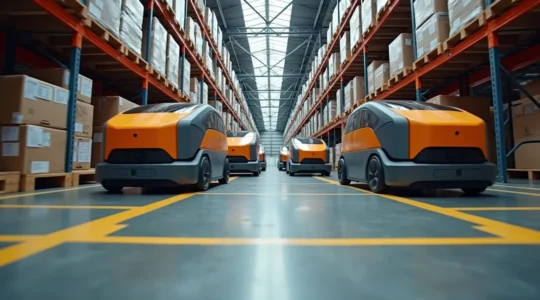
Successfully integrating AGVs is less about the robots you buy and more about re-engineering your warehouse’s operational nervous system first. Automating flawed, unoptimized processes with robots is the fastest way to burn capital and guarantee a negative ROI. True human-robot…
Read more
The common belief that adding more data streams like weather guarantees ETA accuracy is fundamentally flawed; true predictive power comes from algorithmic data fusion. Carrier-provided ETAs and third-party aggregator predictions are often contradictory. The solution is not to choose one,…
Read more
The key to preventing pharmaceutical spoilage is not just monitoring temperature, but scientifically validating the entire cold chain by interpreting the cumulative thermal stress on a product. Mean Kinetic Temperature (MKT) offers a more accurate measure of thermal impact than…
Read more
Successful IoT pallet tracking relies not on the hardware, but on mastering the critical configuration trade-offs that prevent battery drain and data overload. Network choice (e.g., NB-IoT vs. Sigfox) and reporting frequency directly impact multi-year battery life, a crucial factor…
Read more
Calculating logistics tech ROI isn’t about software features; it’s about translating eliminated operational friction into a language your CFO understands. Focus on quantifying the “cost of inaction”—the money you’re already losing to legacy system maintenance, manual errors, and inefficient workflows….
Read more
The relentless pressure to pick faster often creates more errors, hurting your bottom line and team morale. True speed comes from systematically eliminating wasted motion (physical friction), not from rushing. Guiding workers with systems like Pick-to-Light reduces mental guesswork (cognitive…
Read more
True last-mile optimization isn’t a trade-off; it’s about eliminating systemic inefficiencies to cut costs and boost speed simultaneously. Pinpoint specific operational nodes—like route density, picking accuracy, and communication gaps—that inflate costs more than fuel or wages. Leverage technology, from AI-powered…
Read more