
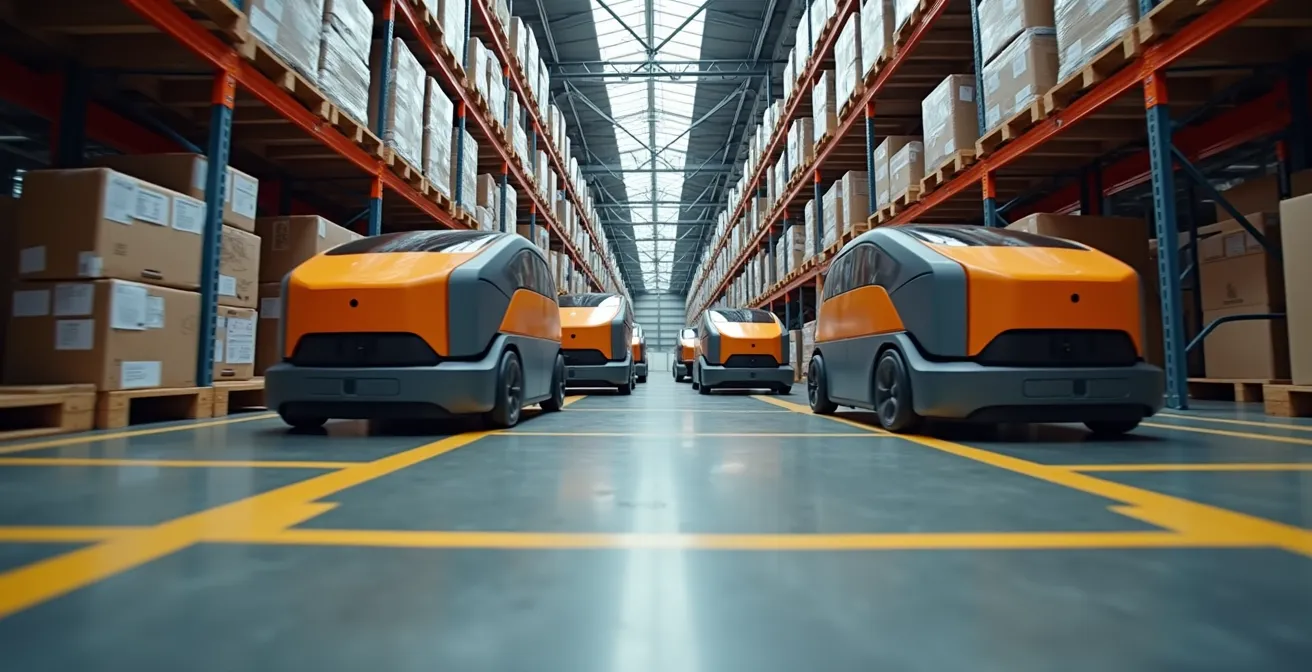
Successfully integrating AGVs is less about the robots you buy and more about re-engineering your warehouse’s operational nervous system first.
- Automating flawed, unoptimized processes with robots is the fastest way to burn capital and guarantee a negative ROI.
- True human-robot collaboration requires deliberate process choreography and a robust digital infrastructure, not just basic training sessions.
Recommendation: Initiate a comprehensive process audit and network infrastructure analysis before even evaluating a single vehicle.
For any warehouse operations director, the promise of Automated Guided Vehicles (AGVs) is immense: drastically reduced labor costs, enhanced picking accuracy, and a clear path to 24/7 productivity. The vision is a seamless floor where robots glide effortlessly, transporting goods and eliminating the costly, error-prone manual travel that dominates a picker’s day. The common advice is to compare vehicle specs, lay down some guidance tape, and conduct a few training sessions. But this approach is precisely why many automation projects underdeliver or fail outright.
The reality is that dropping robots into an inefficient environment is like putting a Formula 1 engine in a horse-drawn cart. You’re just accelerating the underlying problems. The true challenge isn’t a hardware decision; it’s a deep, systemic one. If the fundamental key to unlocking automation’s full potential wasn’t the robot itself, but rather the health of the digital nervous system that controls it? This perspective transforms the integration from a simple purchase into a strategic re-engineering of your entire fulfillment engine.
This guide moves beyond surface-level comparisons to provide a practical engineering blueprint. We will dissect the critical choices you need to make, from selecting the right type of vehicle to designing the human-robot interactions. We’ll explore why process optimization must precede automation, how to build a resilient network infrastructure that prevents costly downtime, and when to strategically scale your fleet. Finally, we’ll connect these technical pillars to proven operational strategies like high-velocity e-commerce fulfillment and the continuous improvement philosophy of Kaizen.
This article provides a structured roadmap for directors aiming not just to install robots, but to build a truly intelligent, automated warehouse. The following summary outlines the key stages of this journey, from foundational decisions to advanced optimization.
Summary: A Blueprint for Integrating AGVs into Your Warehouse
- Guided Vehicles (AGV) vs Autonomous Mobile Robots (AMR): Which Fits Dynamic Layouts?
- How to Train Staff to Work Alongside Robots Without Causing Accidents?
- Why Buying Robots Fails to Deliver ROI if You Don’t Optimize the Process First?
- The Network Blind Spot That Leaves Robots Stranded in the Aisles
- When to Add More Units to the Fleet: Recognizing the Tipping Point of Efficiency?
- How to Speed Up Order Picking Accuracy Without Increasing Human Error Rates?
- How to Update Warehousing Strategies for High-Velocity E-Commerce Fulfillment?
- How to Improve Operational Performance Using Kaizen in a Busy Warehouse?
Guided Vehicles (AGV) vs Autonomous Mobile Robots (AMR): Which Fits Dynamic Layouts?
The first major decision point in any warehouse automation journey is the choice between AGVs and Autonomous Mobile Robots (AMRs). The distinction goes far beyond navigation. AGVs are the workhorses of predictability. They follow fixed paths, typically defined by magnetic tape, wires, or optical sensors. This makes them ideal for repetitive, A-to-B material transport in a stable environment, such as moving finished goods from production to a staging area. Their technology is mature, reliable, and generally involves a lower initial unit cost.
AMRs, in contrast, are the agents of flexibility. Using advanced technologies like LiDAR and SLAM (Simultaneous Localization and Mapping), they create a digital map of the facility and can navigate dynamically, intelligently maneuvering around unexpected obstacles like a misplaced pallet or a group of workers. This adaptability makes them perfectly suited for dynamic, high-velocity environments like e-commerce fulfillment centers, where layouts can change and paths are rarely clear. While their unit cost is higher, they require minimal infrastructure changes, allowing for rapid deployment and easy scalability.
The choice is not about which is “better,” but which is right for the task. A 3PL provider, for instance, successfully created a hybrid system. It used AGVs for predictable “highway” routes between depot zones while deploying AMRs for flexible last-mile tasks within dynamic picking areas. This demonstrates the power of a mixed-fleet strategy, a concept we call process choreography. The following table provides a deeper look into the total cost of ownership, a critical factor beyond the initial sticker price.
| Factor | AGV | AMR |
|---|---|---|
| Initial Investment | Lower unit cost ($15,000-$40,000) | Higher unit cost ($25,000-$70,000) |
| Infrastructure Changes | Magnetic tape/wire guidance ($5-10 per meter) | Minimal infrastructure required |
| Implementation Time | 2-4 weeks for fixed routes | 1-2 weeks, flexible deployment |
| ROI Period | 22 months average | 12 months for flexible operations |
| Maintenance Cost | Lower, simpler technology | Higher, complex sensors and AI |
| Flexibility | Fixed paths, predictable routes | Dynamic navigation, adapts to obstacles |
How to Train Staff to Work Alongside Robots Without Causing Accidents?
Introducing robots into a human-centric workspace is fundamentally a cultural and psychological shift, not just a technical one. The primary goal of training is not just to teach rules, but to build trust and demystify the technology. A safe warehouse is an efficient warehouse, and with over 3 million annual work-related deaths globally, leveraging automation to reduce human exposure to hazards is a powerful motivator. Effective training focuses on creating a predictable environment where both humans and robots understand the rules of engagement.
This involves moving beyond one-off presentations to a continuous program of role-specific education. An operator who interacts with AGVs daily needs hands-on skills to handle exceptions, while a maintenance technician requires deep technical troubleshooting knowledge. The most effective programs use realistic simulations, allowing staff to experience and react to various scenarios—from normal operations to emergency stops—in a controlled setting. This builds muscle memory and confidence.
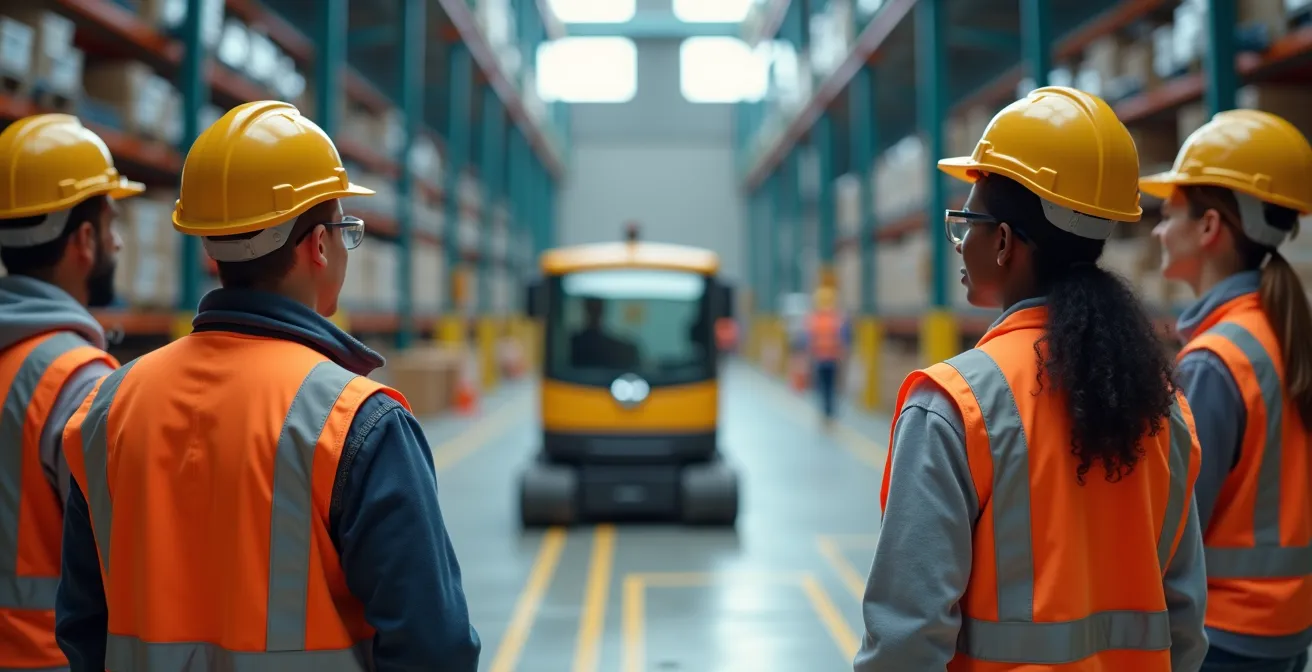
As the image above illustrates, observation and hands-on learning are key. The goal is to establish a clear process choreography where human and robotic movements are harmonized. This includes establishing clear right-of-way protocols, pedestrian-only zones, and universally understood audio-visual alerts. To anchor this in your organization, appointing internal “AGV Champions”—super-users who receive advanced training—creates an invaluable on-the-floor resource to support colleagues and reinforce best practices long after the initial implementation.
Action Plan: Implementing a Human-Robot Collaboration Framework
- Define Protocols: Establish and clearly communicate right-of-way rules, safe interaction zones, and standardized emergency procedures for all human-AGV encounters.
- Develop Role-Specific Training: Create distinct training modules for operators (hands-on interaction), floor staff (awareness and safety), and maintenance teams (technical troubleshooting).
- Simulate Real-World Scenarios: Use a designated training area to run realistic simulations, covering both normal operations and common exception-handling situations (e.g., a blocked path).
- Conduct Safety Audits & Drills: Regularly audit adherence to safety protocols and conduct unannounced emergency drills to test and reinforce response procedures.
- Appoint AGV Champions: Identify and provide advanced training to internal champions who will serve as go-to experts and knowledge hubs for their peers on the floor.
Why Buying Robots Fails to Deliver ROI if You Don’t Optimize the Process First?
The most common and costly mistake in warehouse automation is what engineers call “paving the cowpaths”—automating an existing, inefficient process. When you do this, you don’t eliminate waste; you just make your flawed process run faster, locking in its inefficiencies at a significant capital expense. The allure of a quick hardware fix often masks deep-seated process issues like convoluted travel paths, poor inventory slotting, or redundant steps. True ROI doesn’t come from the robot; it comes from the process redesign that automation enables.
Before a single AGV is purchased, a comprehensive process audit using methodologies like Value Stream Mapping is non-negotiable. This exercise forces you to meticulously document every step of your current material flow, identify bottlenecks, and eliminate non-value-added activities. One manufacturing client, for example, first optimized its workflow patterns and eliminated redundant movements before deployment. The result? A staggering 40% decrease in material flow time after implementing AGVs. The robots were the enablers, but the process optimization was the true source of the savings.
Case Study: The Pitfall of Legacy System Integration
The complexity of integrating new robotic systems with legacy software is a primary barrier to success. As one market analysis highlights, many facilities struggle to connect their AGV fleet management software with outdated ERP and WMS systems. This disconnect leads to data silos, inefficient task allocation, and an inability to dynamically re-prioritize orders, severely crippling the potential of the automated fleet. This underscores the need for a holistic, systemic integration strategy that considers software and data flow as core components, not afterthoughts.
Furthermore, achieving a positive return is a long-term commitment. While impressive, even optimized systems require time to pay for themselves, with industry models showing an average of a 22-month payback period for AGVs running three shifts. This timeline can extend dramatically if you haven’t done the upfront process work. As experts at Market Growth Reports note in their 2024 analysis:
Integration complexity and high initial deployment cost remain the primary barriers, with 43% of surveyed manufacturing facilities indicating difficulty integrating new robots with legacy ERP and WMS systems
– Market Growth Reports, AGV/AMR Market Analysis 2024
The Network Blind Spot That Leaves Robots Stranded in the Aisles
An AGV fleet is only as smart as the network that connects it. This is the digital nervous system of your warehouse, and it’s an area where cutting corners can lead to catastrophic failure. A single Wi-Fi dead spot in a remote aisle or a moment of high network latency can leave a multi-thousand-dollar robot stranded, causing a cascade of delays that brings operations to a standstill. The reliability of your wireless infrastructure is not an IT issue; it’s a core operational continuity requirement.
A robust AGV network strategy begins with a thorough site survey to map wireless coverage and identify any potential blind spots, especially along critical travel routes, in high-density racking areas, and near charging stations. Best practice involves implementing a dual-band Wi-Fi setup: the more crowded 2.4GHz band can be used for basic control signals, while the higher-bandwidth 5GHz or 6GHz bands are reserved for primary data transmission and navigation. Optimizing roaming performance between access points is also crucial to prevent packet loss as vehicles move throughout the facility.
Beyond performance, security is a paramount concern. An unsecured AGV network is a prime target for malicious actors. These systems are part of the broader Industrial Internet of Things (IIoT) landscape, which is increasingly under attack. For instance, security researchers recorded 37 ransomware probes against material-handling networks in just the first three quarters of 2024. For mission-critical zones, some operations are even deploying private 5G/LTE networks as a highly secure and reliable failover. Implementing controllers compliant with security standards like IEC 62443-4-2, which include hardware root-of-trust, is becoming the new baseline for protecting your robotic assets and the operational data they carry.
When to Add More Units to the Fleet: Recognizing the Tipping Point of Efficiency?
Once your initial AGV fleet is operational, the next challenge is scalability. The question isn’t simply “when should we buy more robots?” but “at what point does adding another unit increase throughput, and at what point does it just create more congestion?” This is the tipping point of efficiency, and identifying it requires a shift from gut feeling to data-driven fleet intelligence. With industry projections indicating 700,000 mobile robots will be shipped by 2030, mastering fleet optimization is a key competitive advantage.
The gold standard for this is Amazon, which uses sophisticated queuing theory models to manage its massive Kiva robot fleet. Rather than simply adding units, they monitor key performance indicators (KPIs) like task queue length and AGV wait times. When the queue of pending tasks grows consistently and robots are spending more time waiting for assignments than traveling, it signals that the current fleet is at capacity. Conversely, if AGVs are frequently waiting for paths to clear or are creating traffic jams, it suggests the system has reached its congestion point, and adding more units would be counterproductive without route or process optimization.
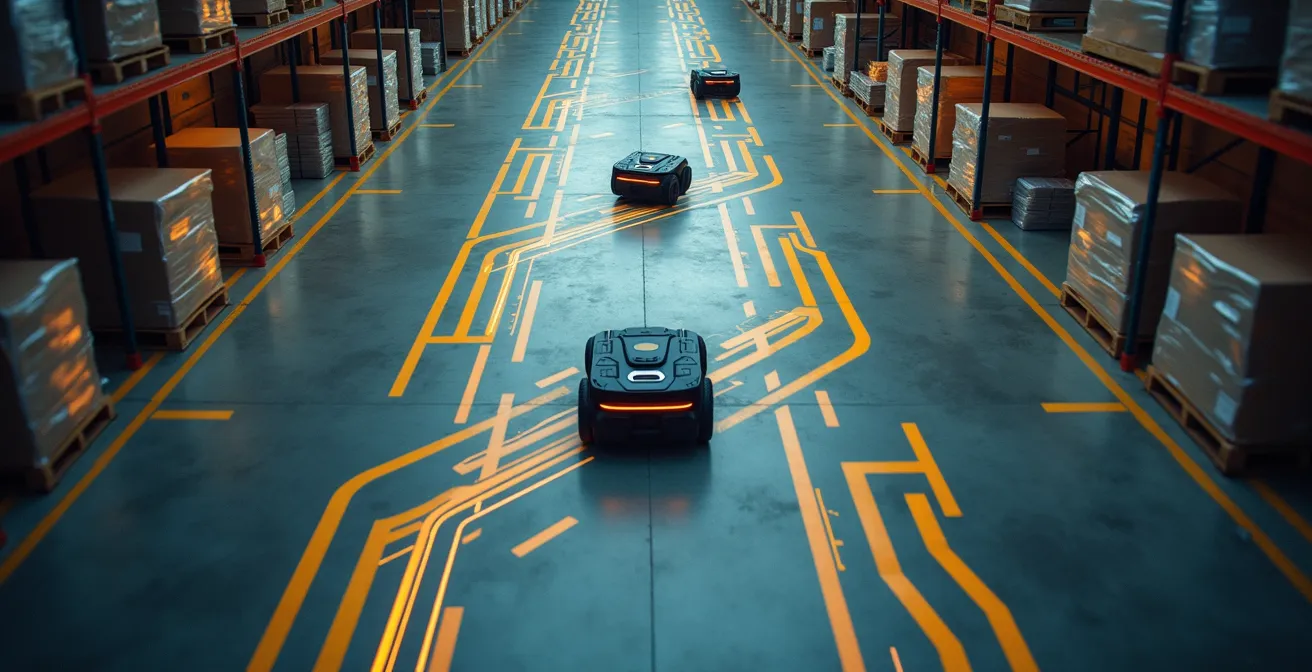
This is where the concept of a digital twin becomes invaluable. A digital twin is a virtual model of your warehouse that can simulate the impact of adding more AGVs to the fleet. By running simulations with different fleet sizes and order volumes, you can accurately predict the point of diminishing returns. This allows you to make investment decisions based on predictive data, ensuring each new robot added to the floor contributes directly to improved efficiency rather than simply becoming another vehicle in a robotic traffic jam.
How to Speed Up Order Picking Accuracy Without Increasing Human Error Rates?
Order picking is the most labor-intensive and error-prone process in most warehouses. The constant pressure to increase speed often leads to more mistakes, resulting in costly returns and dissatisfied customers. AGVs and AMRs fundamentally solve this by inverting the traditional “person-to-goods” model. Instead of having pickers waste up to 60% of their day walking miles between storage locations and packing stations, a “goods-to-person” system brings the inventory directly to them.
In a goods-to-person (GTP) workflow, a picker remains at a stationary, ergonomically designed workstation. When an order is received, the Warehouse Management System (WMS) dispatches an AMR to retrieve the required storage tote or shelf and deliver it to the workstation. This simple change has a profound impact. An analysis by Lilly Forklifts suggests that even if an AGV only eliminated half of the wasted walking time, that’s 30% more time pickers spend fulfilling orders. The result is a dramatic increase in throughput without adding headcount.
Crucially, this model also decouples speed from accuracy. With the picker stationary, workstations can be equipped with technologies that virtually eliminate human error. These include:
- Pick-to-light systems: Lights direct the picker to the exact bin and indicate the quantity to pick.
- Scanners: Barcode scanners at every step validate that the correct item is being picked from the correct tote and placed in the correct order container.
- On-screen displays: Visual cues and product images provide an additional layer of verification.
This combination of robotic transport and technology-assisted picking allows warehouses to achieve near-perfect accuracy rates while simultaneously seeing a significant 37% reduction in pick-to-ship times. The human worker is elevated from a manual laborer to a skilled operator, focused on the value-added task of picking, guided by a system designed for precision.
How to Update Warehousing Strategies for High-Velocity E-Commerce Fulfillment?
The rise of e-commerce has shattered traditional warehousing models. Customers now expect next-day or even same-day delivery, forcing distribution centers to operate at unprecedented velocities. This high-speed environment is where AGV and AMR systems truly shine, enabling strategies that would be impossible with manual labor alone. With the retail and e-commerce AGV segment expected to advance at an 8.23% CAGR through 2030, adopting these strategies is becoming a matter of survival.
One of the most effective strategies is zoned picking. Instead of having one picker traverse the entire warehouse for an order, the facility is divided into smaller, compact zones based on product velocity (e.g., high-demand items in Zone A, medium in Zone B). Pickers are assigned to a specific zone and only pick items from that area. AGVs or AMRs then act as a smart conveyor system, transporting order containers from one zone to the next until the order is complete. This minimizes human travel, maximizes picking density, and dramatically accelerates fulfillment.
This automated foundation enables several other high-velocity strategies:
- Waveless Fulfillment: Traditional wave picking involves grouping orders into large batches, which creates start-stop cycles. With AGVs, orders can be released continuously in a “waveless” model, allowing for a constant, smooth flow of work and enabling much later order cut-off times.
- Dynamic Slotting: The WMS can use data from the AGV fleet to dynamically re-slot inventory, moving high-velocity SKUs closer to packing stations in real-time to minimize robotic travel distance.
- Micro-Fulfillment: Companies can position small, highly automated micro-fulfillment centers (MFCs) in urban areas. These MFCs use dense AMR-based systems to fulfill online orders for last-mile delivery in a matter of hours, not days.
By integrating the AGV fleet management system directly with the WMS, operations directors can achieve a level of real-time order prioritization and resource allocation that transforms the warehouse from a cost center into a strategic competitive weapon.
Key Takeaways
- Systemic Integration First: True automation ROI comes from re-engineering your processes and digital infrastructure before buying hardware.
- Human-Robot Choreography: Treat staff training as a continuous program to build trust and harmonize workflows, not a one-time event.
- Data-Driven Scalability: Use fleet performance data and digital simulations to determine the optimal time to add more units, avoiding costly congestion.
How to Improve Operational Performance Using Kaizen in a Busy Warehouse?
Kaizen, the philosophy of continuous improvement, is the engine that sustains and enhances the performance of an automated warehouse long after the initial implementation. An AGV fleet is not a static asset; it is a rich source of operational data. Every trip, every delay, and every task completion is a data point that can be used to identify bottlenecks and refine processes. This creates a powerful feedback loop for improvement, turning the warehouse into a living, learning system.
The average human worker makes between 5 to 15 mistakes per hour; robots, guided by data, make virtually none. But their value goes beyond error reduction. The fleet management dashboard becomes the modern equivalent of a “Gemba walk,” the Kaizen practice of going to the actual workplace to observe. From this dashboard, a director can conduct a digital Gemba walk, visualizing traffic flows, identifying areas of congestion, and spotting underutilized assets without ever leaving their office. This data provides the objective foundation for the Plan-Do-Check-Act (PDCA) cycle, the core methodology of Kaizen.
Ford’s Dearborn assembly plant offers a compelling example. The facility uses AGV-generated data to continuously optimize the routes of its 350-vehicle fleet. By analyzing real-time performance metrics, they identify bottlenecks and refine paths, reducing material handling time from 45 minutes to just 12 minutes per batch. This is Kaizen in action: using objective data (Check) to identify an improvement opportunity (Plan), implementing a change in the AGV routing software (Do), and then measuring the impact on performance (Act). This cycle ensures that efficiency gains are not a one-time project but an ongoing operational discipline, driven by the very fleet intelligence the robots provide.
The journey to a fully automated, intelligent warehouse is a marathon, not a sprint. It demands a systemic view that balances hardware, software, processes, and people. The next logical step is to move from strategy to action by initiating a full-scale process and infrastructure audit. This foundational work is what separates a successful automation project from a collection of expensive, underutilized machines.