
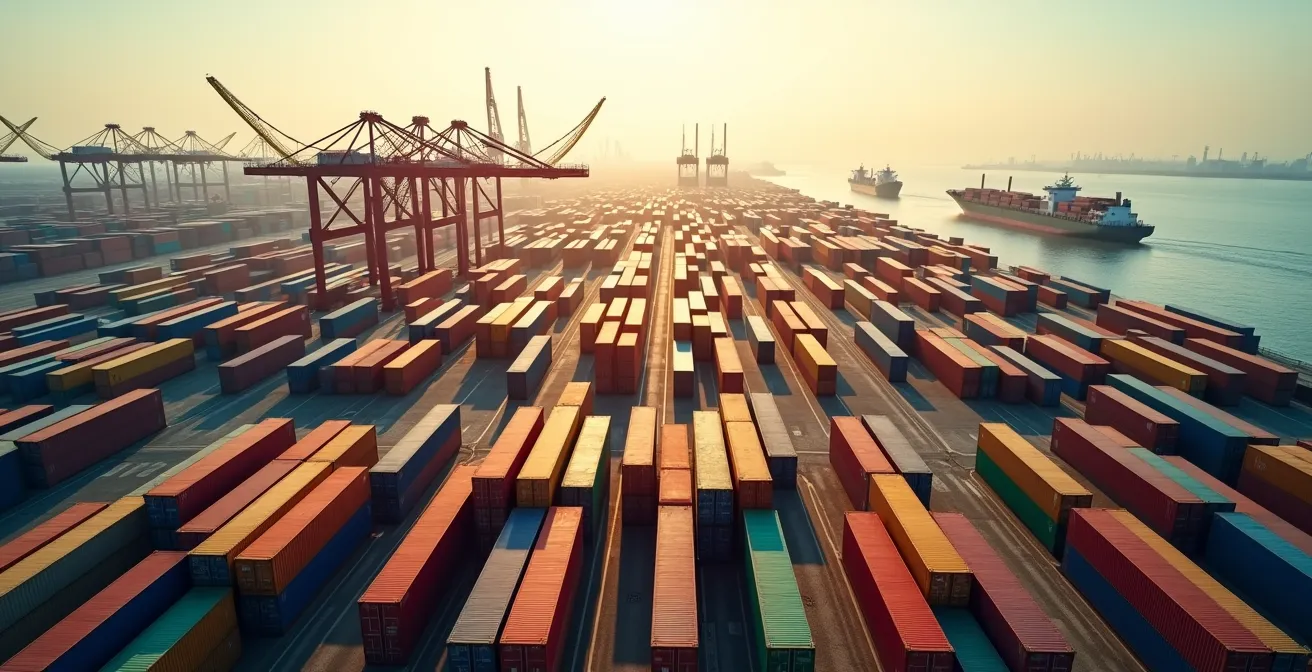
Securing container space is not about luck; it’s about outsmarting the system by understanding the operational game carriers play.
- Carriers manage profitability with “blank sailings,” which you must anticipate through proactive forecasting, not reactive booking.
- Flawless documentation and strategic alliance selection make you a “shipper of choice,” reducing your risk of being rolled.
Recommendation: Shift from simply booking freight to actively managing it. Start by auditing carrier invoices for hidden overcharges and inspecting every container before loading—these are levers you control.
As an import/export manager, you’ve felt the sting of a last-minute sailing cancellation. A perfectly timed shipment, crucial for a just-in-time (JIT) production line or a retail promotion, suddenly vanishes from the schedule, leaving you scrambling. The common advice—”book earlier” or “build better relationships”—feels hollow when carrier networks are opaque and capacity is a moving target. You’re told to be flexible, but your supply chain demands predictability. This constant uncertainty feels like a game where the rules are always changing, and you’re always one step behind.
The truth is, it *is* a game. But it’s not a game of chance. It’s an operational game with clear, if unwritten, rules dictated by carrier profitability, network efficiency, and risk management. The key to winning isn’t just paying more or hoping for the best. It’s about understanding the mechanics behind carrier decisions, from how they deploy vessel alliances to the subtle ways they calculate surcharges. It’s about transforming your shipping process from a series of transactions into a strategic operation.
What if the solution wasn’t finding more capacity, but becoming the kind of customer that capacity finds? This guide moves beyond the platitudes. We will dissect the carrier playbook, providing you with the insider knowledge to not only secure space but also protect your budget and ensure your cargo arrives safely. We’ll show you how to turn your documentation into leverage, how to forecast your needs like a carrier, and how to spot the costly errors they hope you’ll miss.
This article will provide a clear roadmap to navigate the complexities of modern ocean freight. By understanding the underlying systems, you can move from a position of reaction to one of strategic control, ensuring your cargo gets the priority it deserves.
Summary: A Shipper’s Guide to Navigating Sea Freight Volatility
- Why carriers cancel sailings suddenly and how it destroys your just-in-time plan?
- How to forecast container needs 4 weeks out to guarantee slot availability?
- 2M vs Ocean Alliance vs THE Alliance: Which network offers better reliability on Transpacific lanes?
- The invoice error that allows carriers to overcharge BAF and CAF fees
- How to negotiate longer free time at destination to avoid storage penalties?
- How to match your cargo to the right freight vessels for project shipments?
- How to inspect standardized ISO containers to prevent water damage to high-value goods?
- How to calculate the logistics carbon footprint of a multi-leg international shipment accurately?
Why carriers cancel sailings suddenly and how it destroys your just-in-time plan?
Carriers cancel sailings, a practice known as “blank sailings,” primarily as a tool to manage capacity and maintain freight rates. When demand softens or is predicted to fall, removing a vessel from a scheduled loop prevents rates from plummeting due to oversupply. This is a strategic financial decision, not a random operational failure. For your JIT plan, the effect is catastrophic. It introduces an immediate delay of at least one week, creating a bullwhip effect that disrupts production schedules, risks stock-outs, and can lead to lost sales and penalty clauses with your own customers.
The scale of this practice is significant. During periods of predictable lulls, such as the post-Chinese New Year slowdown or national holidays, carriers systematically withdraw capacity. For instance, an analysis of market behavior shows that during a major holiday period like Golden Week, carriers can remove 250,000 to 300,000 TEU of capacity from major trade lanes. This isn’t a possibility; it’s a planned part of their business model. When this happens, your cargo is at risk of being “rolled”—postponed to a subsequent sailing—especially if your booking is considered lower yield or your documentation is incomplete.
To a carrier, not all cargo is equal. In a capacity crunch, they prioritize high-revenue freight and “shippers of choice” who provide accurate information and are easy to do business with. Incomplete or late documentation is one of the fastest ways to get your container pushed to the next vessel. The carrier’s logic is simple: a container with uncertain paperwork is a high-risk asset that could cause delays at customs or incur fines. They will always opt for the cargo that is guaranteed to move smoothly. Therefore, mastering your documentation process is the first line of defense against the chaos of blank sailings.
How to forecast container needs 4 weeks out to guarantee slot availability?
Forecasting container needs four weeks out requires shifting from a transactional booking mindset to a strategic, data-driven approach that mirrors carrier planning cycles. You must synthesize your internal sales and inventory data with external market intelligence. This involves tracking carrier capacity announcements, holiday schedules (like Golden Week), and macroeconomic indicators that influence consumer demand. By creating a rolling four-to-six-week forecast, you provide carriers with the visibility they crave, positioning yourself as a predictable and valuable partner.
This process must be dynamic, not static. Market conditions can shift rapidly, requiring constant adjustments. A prime example is how geopolitical events impact routing. As described by a leading logistics provider, the Red Sea crisis forced carriers to divert vessels around the Cape of Good Hope. To maintain weekly service integrity on these longer routes, they had to inject more vessels into their loops. Shippers who quickly adjusted their forecasts to account for these longer transit times were better positioned to secure space. This is validated by market data, where organizations like the National Retail Federation revised its import growth forecast upward by 3 percentage points in early 2024 to account for these network shifts.
This level of analysis turns forecasting into a powerful negotiating tool. Instead of asking for space on short notice, you are presenting a predictable volume commitment. You can approach carriers with a clear plan: “We will require approximately 20 TEUs from Shanghai to Los Angeles in week 42, with a potential 10% upside.” This language allows them to slot your anticipated volume into their own vessel planning, dramatically increasing your chances of securing a slot allocation, even during peak season. It transforms you from a price-taker into a strategic partner.

Visualizing this data through dashboards that overlay your demand projections with market capacity trends is crucial. It allows you to spot potential bottlenecks weeks in advance and make proactive decisions, such as splitting shipments across multiple carriers or pre-booking space on a less-congested service. This is the essence of playing the operational game: using information to act, not just react.
2M vs Ocean Alliance vs THE Alliance: Which network offers better reliability on Transpacific lanes?
On Transpacific lanes, no single alliance offers guaranteed reliability, as performance fluctuates based on port congestion, labor issues, and internal capacity management. However, historically, alliance behavior shows distinct patterns. The key to selection is not finding a “perfect” alliance but understanding their different operational philosophies. For example, some alliances may prioritize maintaining a fixed schedule even if it means implementing more blank sailings, while others might be more prone to vessel sliding and port omissions to keep their network flowing.
The overall market context is one of poor performance. With global schedule reliability hovering around 54.4% as of mid-2024, a significant drop from pre-pandemic levels of 75-80%, choosing an alliance becomes an exercise in risk mitigation. You must analyze real-time data on on-time performance, cancellation frequencies, and average delays for each alliance on your specific trade lane. This data, available through maritime analytics platforms and forwarder intelligence reports, is far more valuable than a carrier’s marketing promises.
Analyzing blank sailing data provides critical insight into how each alliance manages capacity. For example, in a given quarter, one alliance might blank 16% of its Transpacific schedules, while another aggressively cancels specific loops to rebalance its network. This information helps you assess the real-world risk to your supply chain.
The table below, based on Q4 2023 and early 2024 trends, illustrates how differently alliances can behave in their capacity management on Asia-Europe routes, with similar logic applying to the Transpacific.
| Alliance | Q4 2023 Blank Sailings (TEU) | Q1 2024 Activity | Average Vessel Size (TEU) |
|---|---|---|---|
| 2M Alliance | 644,572 | Significantly reduced sailings | 18,000-20,000 |
| Ocean Alliance | Multiple AE1/AE7 cancellations | 3-4 cancellations per week (wks 39-41) | 18,600 |
| THE Alliance | 16% of schedules affected | Moderate reduction | 15,000-18,000 |
Ultimately, the smartest strategy is diversification. Relying on a single alliance, no matter its reputation, exposes you to its specific network vulnerabilities. By allocating your volume across at least two different alliances, you hedge your bets. When one network experiences a meltdown at a key terminal or announces a wave of blank sailings, you have an alternative route for your critical cargo.
The invoice error that allows carriers to overcharge BAF and CAF fees
One of the most common and costly invoice errors involves the incorrect application date for surcharges like the Bunker Adjustment Factor (BAF) and Currency Adjustment Factor (CAF). Carriers often bill these floating surcharges based on the rate effective on the date of sailing, not the date of booking confirmation. If your contract or rate agreement locks in rates at the time of booking, but the BAF increases before the vessel departs, you can be illegally overcharged. This discrepancy can amount to hundreds of dollars per container and is frequently missed in routine invoice checks.
This “rate shifting” is just one of several ways costs can inflate between quote and invoice. Another is the misapplication of a General Rate Increase (GRI). A GRI should only apply to new bookings made after its effective date. However, it’s not uncommon for a carrier’s automated billing system to incorrectly apply it to shipments booked under a pre-existing, fixed-rate contract. Without a meticulous audit process, you will pay this inflated rate without challenge.

The only defense is a systematic and rigorous freight audit process. This goes beyond simply matching the invoice total to the quote. It requires a line-by-line validation of every single charge against the original rate confirmation and the governing tariff rules. You must verify the effective dates for every surcharge, confirm that detention and demurrage clocks start only when the container is actually available for pickup (not just when the vessel docks), and challenge any emergency surcharges that weren’t officially announced or don’t apply to your trade lane.
Documenting everything is non-negotiable. Every rate confirmation, every email exchange, and every booking detail should be saved and organized. When you find a discrepancy, your dispute claim should be surgical, including screenshots of the original agreement and a clear calculation of the overcharge. Carriers are far more likely to issue a credit note for a well-documented, precise claim than a vague complaint.
Your Action Plan: Auditing Freight Invoices for Surcharges
- Verify BAF/CAF calculation date matches your booking confirmation, not the sailing date.
- Check if a General Rate Increase (GRI) was incorrectly applied to existing contract rates.
- Confirm the detention clock start time aligns with the actual container availability notification.
- Validate inland haulage charges against the original quote, accounting for any fuel surcharges.
- Cross-reference any emergency surcharges with the carrier’s official announcements and applicability dates.
How to negotiate longer free time at destination to avoid storage penalties?
To negotiate longer free time, you must present a compelling business case that frames your request not as a concession, but as a tool for mutual efficiency. Instead of simply asking for more days, propose a tiered structure tied to your volume commitments. This demonstrates partnership and provides a clear incentive for the carrier. For example, you can negotiate a baseline of 7 standard free days, which extends to 10 days in any month your volume exceeds 50 TEUs, and 14 days for months over 100 TEUs. This turns the negotiation from a zero-sum game into a win-win scenario.
This approach has proven successful for large-volume shippers. An automotive parts importer, for instance, not only secured a tiered free time structure but also pre-negotiated reduced per-diem rates for any overage. By agreeing to a rate of $75/day for days 8-14 (versus a standard of $150), they created a cost-controlled buffer to manage unpredictable customs delays. This strategy shows the carrier you are planning for contingencies and managing your costs proactively, reinforcing your status as a “shipper of choice.”
The foundation of any such negotiation is data. You need to analyze your historical container dwell times to understand your actual needs. If your data shows that 80% of your containers clear customs within 8 days, but the remaining 20% are frequently delayed to 12 days due to specific commodity inspections, you can build a targeted request for 14 days of free time specifically for that cargo type. This data-backed approach is far more persuasive than a generic request for more time on all shipments.
Even with advanced warnings from carriers about schedule changes, delays are inevitable. As the InterlogUSA Analytics Team noted in a recent report, this reality underscores the need for a buffer. Their insight highlights the core issue:
Carriers typically give shippers a heads up in advance of a blanked sailing, however the tactic nonetheless can lead to delays
– InterlogUSA Analytics Team, Interlog Insights April 2024 Report
This is precisely why negotiated free time is a critical component of risk management. It’s not about getting something for free; it’s about building predictable, manageable costs into a system that is inherently unpredictable.
How to match your cargo to the right freight vessels for project shipments?
Matching project cargo to the right vessel requires moving beyond the world of standard TEUs and entering the specialized domain of breakbulk, Roll-on/Roll-off (RoRo), and heavy-lift vessels. The first step is a meticulous cargo assessment. You must have precise, engineered specifications for your out-of-gauge (OOG) or heavy cargo, including exact dimensions, weight, center of gravity, and all lifting/lashing points. This is not a job for estimates; it requires certified technical drawings, as the vessel’s master and port captain will use this data to create a safe and stable stowage plan.
With this data, you can identify the appropriate vessel type. Is your cargo self-propelled, like a large piece of construction equipment? A RoRo vessel is the ideal choice. Is it a massive, static component like a turbine or a generator? You’ll need a heavy-lift vessel equipped with powerful cranes capable of handling the weight. For complex projects with multiple components of varying sizes, a multi-purpose vessel (MPV) or breakbulk carrier offers the most flexibility. While the global fleet of over 5,600 container ships gets the most attention, a specialized fleet exists precisely for these challenges.
Booking project cargo is fundamentally different from booking a container. It’s a highly detailed process that demands extensive documentation far in advance. You must be prepared to submit a comprehensive package to the carrier’s special cargo division, which should include:
- Detailed technical drawings with exact dimensions and center of gravity.
- Weight distribution plans showing all load points.
- Engineer-certified specifications for all lifting and lashing points.
- 3D CAD models for unusually shaped or complex items.
- A list of all required special equipment, such as spreader beams or shackles.
- Full documentation for any hazardous materials.
- A plan for port captain supervision during loading and discharge.
This level of detail is non-negotiable. Any ambiguity can lead to the carrier rejecting the cargo or, worse, a catastrophic failure during lifting or transit.
The final piece of the puzzle is port logistics. You must confirm that both the port of loading and the port of discharge have the infrastructure to handle your cargo. This includes checking for adequate quay strength, crane capacity, and on-the-ground transport options for the final leg of the journey. Forgetting this step can result in your multi-million dollar cargo being stranded on a vessel with no way to safely unload it.
How to inspect standardized ISO containers to prevent water damage to high-value goods?
To prevent water damage, you must implement a mandatory, multi-point inspection protocol for every empty ISO container before a single item is loaded. Do not trust that the container provided by the carrier is seaworthy. A quick visual check is insufficient; you need a systematic process that tests for structural integrity and watertightness. The most effective method is the “light test”: after entering the container, have someone close both doors completely. Wait a few moments for your eyes to adjust, then scan every single wall, seam, and the ceiling for any pinpricks of light, which indicate a potential hole or failed weld.
Beyond the light test, a thorough inspection protocol must cover all critical components of the container. This should be treated as a formal quality control step, with a checklist to ensure nothing is missed. The process includes:
- Undercarriage: Check the corner castings for cracks and ensure the cross members are not bent or buckled.
- Flooring: Walk the entire floor, feeling for soft spots or signs of delamination. Look for chemical stains or popped nails that could damage cargo. Use a moisture meter to ensure readings on the wooden floor are below 14%.
- Walls/Ceiling: After the light test, visually inspect for any signs of corrosion or previous repairs that may be compromised.
- Door Seals: Run your hand along the full length of the rubber gaskets around the doors, feeling for any gaps, cracks, or stiffness that would prevent a proper seal. Verify the locking cams operate smoothly and engage securely.
- CSC Plate: Locate the Container Safety Convention plate on the exterior and verify the “Next Examination Date” is still valid. An expired plate means the container is not legally certified as safe for transit.
This rigorous inspection is your best insurance policy against damage. It allows you to reject a faulty container before it’s loaded, forcing the carrier to provide a suitable replacement.
Case Study: Digital Documentation Prevents a $2 Million Loss
A pharmaceutical shipper faced a recurring problem with cargo damage. They implemented a policy of mandatory 360-degree video documentation of the interior of every container before loading. When a shipment of temperature-sensitive vaccines worth $2 million arrived with water damage, they were able to provide the carrier with timestamped video evidence showing a pre-existing hole in the container roof. Faced with irrefutable proof, the carrier accepted full liability and provided compensation within 30 days, avoiding the typical 6-month dispute process.
This case study demonstrates the power of documentation. Taking timestamped photos or videos of the container’s condition—both inside and out—before loading provides indisputable evidence. If damage occurs, this documentation shifts the burden of proof to the carrier, protecting you from significant financial loss.
Key takeaways
- Blank sailings are a deliberate financial strategy by carriers; anticipate them with proactive forecasting.
- Alliance reliability varies greatly. Diversify your cargo across at least two alliances to mitigate network-specific risks.
- Mastering the details—from meticulous invoice auditing to pre-loading container inspections—gives you control in a volatile market.
How to calculate the logistics carbon footprint of a multi-leg international shipment accurately?
Accurately calculating a shipment’s carbon footprint requires a granular, multi-modal approach that goes beyond generic emissions factors. You must follow the GLEC Framework (Global Logistics Emissions Council) methodology, which breaks the journey down into individual legs and applies specific factors for each. This means calculating emissions for the drayage from the factory to the port, the ocean transit itself, and the final-mile delivery at the destination. The calculation for each leg should consider the specific vehicle or vessel type, fuel used, and distance traveled.
For the ocean leg, which is often the largest contributor, several variables are critical. It’s not enough to know the distance; you must know the vessel size, age, and engine type, as these dramatically affect fuel efficiency. Furthermore, the route itself is a major factor. For example, a shipment from Asia to Europe diverted around the Cape of Good Hope will have a significantly higher carbon footprint than one transiting the Suez Canal, due to the increased distance. While ocean shipping accounts for about 2.9% of global greenhouse gas emissions, your specific routing choices can either mitigate or exacerbate your company’s contribution to that total.
The impact of routing and transshipment choices is not trivial. An extra stop for transshipment adds emissions not just from the feeder vessel but also from the additional crane moves at the hub port. The table below, based on an analysis of routing choices, illustrates these stark differences.
This comparative data, as highlighted in a recent analysis from Lloyd’s List, shows how operational decisions directly translate into environmental impact.
| Route | Distance (nm) | Transit Time | CO2 per TEU | Additional Factors |
|---|---|---|---|---|
| Asia-Europe via Suez | 8,500 | 26 days | Baseline | Direct service, minimal transshipment |
| Asia-Europe via Cape | 11,500+ | 40 days | +35% emissions | No transshipment but longer distance |
| With Singapore transshipment | 8,800 | 30 days | +15% emissions | Extra crane moves, feeder vessel emissions |
To get this right, you need access to credible data. Many freight forwarders and specialized tech platforms now offer carbon calculation tools that are GLEC-accredited. These tools automatically pull real-world vessel data and apply the correct emissions factors, providing you with a reliable, auditable report for your ESG (Environmental, Social, and Governance) initiatives. This isn’t just about compliance; it’s about making smarter, more sustainable supply chain decisions.
By shifting your perspective from simply booking freight to strategically managing it, you change the rules of the game. Mastering forecasting, documentation, and carrier network analysis transforms you from a reactive shipper into a proactive, resilient logistics manager. These strategies are not just for weathering the current capacity crunch; they are the foundation for building a more predictable and cost-effective supply chain for years to come. The next step is to embed these practices into your daily operations. Evaluate your current processes and identify one area—whether it’s invoice auditing or container inspection—where you can implement a more rigorous system today.