
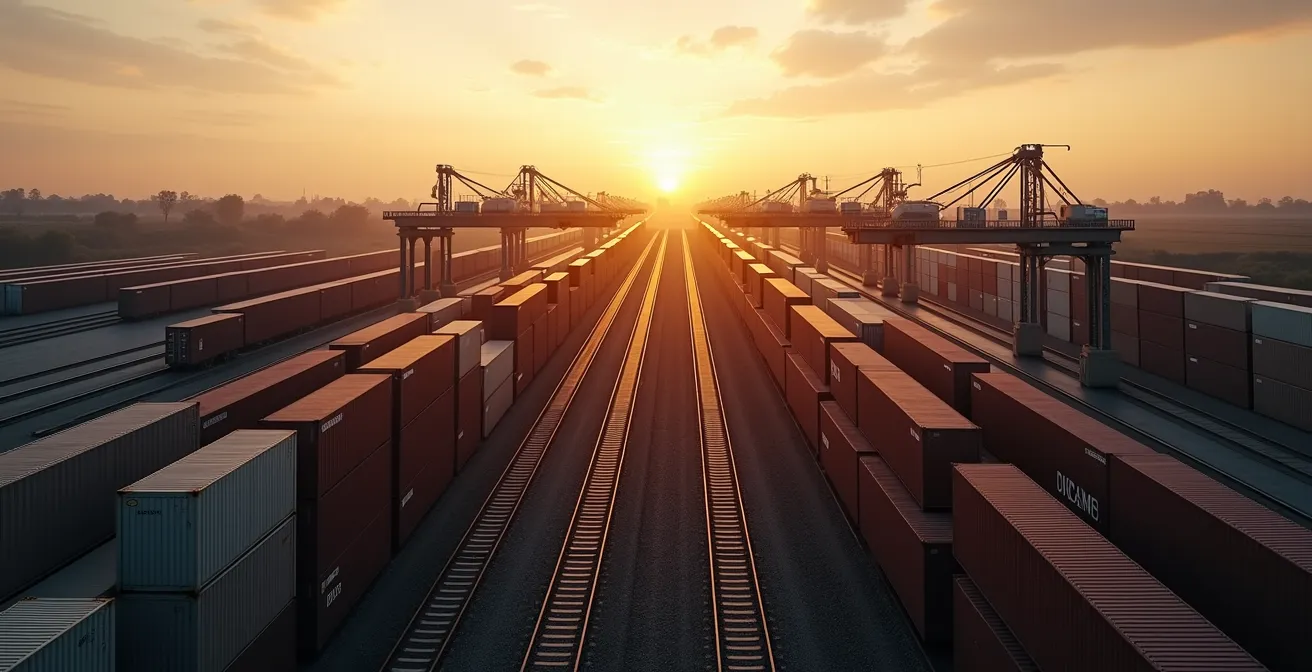
Shifting to rail is not about flipping a switch; it’s a strategic mastery of economic break-even points and operational complexities.
- Rail’s true cost advantage emerges only after a 500-mile threshold due to high fixed terminal costs that must be amortized over distance.
- Systemic risks like peak season capacity crunches and cross-border friction are manageable threats that require proactive contracting and technology integration.
Recommendation: Focus on Total Cost of Ownership (TCO) and granular carbon footprint data—not just freight rates—to build a resilient and truly sustainable long-haul network.
For logistics directors managing vast continental supply chains, the pressure is mounting. Volatile fuel costs are eroding trucking margins, while mounting ESG (Environmental, Social, and Governance) mandates demand a quantifiable reduction in carbon emissions. The conventional wisdom points to a simple solution: shift more volume from road to rail. This advice, however, oversimplifies a complex strategic decision. It ignores the operational realities that can quickly turn a promising modal shift into a costly logistical bottleneck.
The true challenge isn’t deciding *if* you should use rail, but *how* to wield it as a strategic weapon. Success hinges on a deep understanding of its economic tipping points, a proactive approach to managing its inherent risks, and a mastery of the operational friction points that occur at terminals and borders. Simply comparing freight rates is a recipe for failure; it neglects the crucial impacts of inventory carrying costs, drayage fees, and the cascading penalties of a single miscalculation in loading gauge.
This article moves beyond the platitudes. We will dissect the strategic discipline required to make rail a cornerstone of a sustainable and efficient long-haul distribution network. We will not just state that rail is cheaper or greener; we will explore the precise economic and operational levers you must pull. From calculating the real break-even distance to navigating cross-border gauge changes and securing capacity during volatile peak seasons, you will gain the strategic framework of a seasoned rail logistics director. This is your guide to transforming rail from a simple alternative into a powerful competitive advantage.
To navigate these complex strategic layers, this guide is structured to address the most critical decision points you face. Below is a summary of the key operational and economic challenges we will dissect, providing a clear roadmap to mastering long-haul rail logistics.
Summary: Mastering Continental Rail for Sustainable Distribution
- Why rail becomes cheaper than trucking only after 500 miles of distance?
- How to secure rail wagons during the grain harvest peak season?
- Ocean freight vs Silk Road rail: Which balances speed and cost for electronics?
- The loading gauge mistake that leaves your cargo stuck at a tunnel entrance
- How to manage transloading at borders with different rail track widths efficiently?
- How to negotiate Full Truckload road freight haulage rates when fuel costs spike?
- How to optimize flow through intermodal logistics to reduce carbon footprint by 20%?
- How to calculate the logistics carbon footprint of a multi-leg international shipment accurately?
Why rail becomes cheaper than trucking only after 500 miles of distance?
The 500-mile rule is a fundamental principle in freight logistics, but it’s not arbitrary. It’s dictated by the high fixed costs inherent to rail transport. Unlike a truck, which can simply be loaded and dispatched, a rail shipment incurs significant upfront expenses: terminal drayage, container lift-on/lift-off charges, and gate fees. These act as an “entry fee” to the rail network. For short distances, these fixed costs dominate the total price, making trucking the more economical choice. However, as the distance increases, these costs are amortized over more miles, and rail’s superior line-haul efficiency—its lower cost per ton-mile—takes over.
Congressional research analysis confirms this tipping point, showing that for freight journeys longer than 500 miles, more freight moves by rail or multiple modes than by truck alone. Understanding this break-even point is not just about distance; it is about calculating the Total Cost of Ownership (TCO). A slower transit time by rail means higher inventory carrying costs, which must be factored into the equation. For high-value goods, the cost of capital tied up in inventory can sometimes negate the freight savings.
However, this 500-mile benchmark is not static. It is a dynamic variable influenced by market forces and cargo characteristics. For extremely heavy and dense cargo like steel, stone, or bulk chemicals, rail can be cost-effective even on journeys under 500 miles because a single railcar can carry the equivalent of three to four trucks. Furthermore, external shocks like sharp fuel price spikes can dramatically lower the break-even point, sometimes to as low as 300-400 miles, as trucking’s variable costs escalate disproportionately. The strategic logistics manager continuously models these variables to identify opportunities for modal shift long before the competition.
How to secure rail wagons during the grain harvest peak season?
Securing rail capacity during the grain harvest is one of the greatest systemic risks in North American logistics. It’s a predictable, annual surge where demand for covered hoppers massively outstrips supply. With railroads hauling around 1.6 million carloads of grain and other farm products in a typical year, the network operates at its absolute limit. Shippers who wait until the last minute to book capacity are often left with no options or face exorbitant spot market rates. Winning in this environment requires a proactive, long-term procurement strategy, not a reactive tactical approach.

The first step is moving from tactical procurement to strategic forecasting. By leveraging agricultural yield forecasts 3 to 6 months in advance, you can initiate negotiations with carriers long before the market tightens. The most effective strategy is to secure multi-year contracts with Take-or-Pay clauses. While this requires a volume commitment, it guarantees wagon allocation at a predictable cost, insulating your supply chain from market volatility. This transforms rail capacity from a variable into a fixed, reliable asset.
For shippers with insufficient volume to contract full train sets, forming shipper associations is a powerful lever. By pooling volume with other regional producers, you can jointly negotiate for unit trains, gaining the bargaining power of a much larger entity. A further strategic step is to conduct a lease-versus-buy analysis for a private wagon fleet. While this involves significant capital expenditure, owning a core fleet of wagons for peak season can deliver a substantial ROI by eliminating exposure to the spot market and ensuring operational control. This portfolio approach—combining long-term contracts, association bargaining, and potentially owned assets—is the key to navigating the harvest peak with confidence.
Ocean freight vs Silk Road rail: Which balances speed and cost for electronics?
For high-value electronics moving from Asia to Europe, the choice between traditional ocean freight and the “New Silk Road” rail corridor presents a classic speed-versus-cost dilemma. Rail is not a direct replacement for sea freight; it’s a strategic middle ground that offers a compelling balance for the right type of cargo. The decision requires a nuanced analysis of transit time, cost, and risk factors that go far beyond the base freight rate.
The following table breaks down the core trade-offs, providing a clear framework for this strategic decision. Rail cuts transit time roughly in half but at nearly double the cost, while also introducing different risk profiles.
| Factor | Ocean Freight | Silk Road Rail |
|---|---|---|
| Transit Time | 30-35 days | 15-20 days |
| Cost Index | 100 (baseline) | 180-220 |
| Security Risk | Lower (isolated voyage) | Higher (multiple borders) |
| Physical Risk | Saltwater corrosion, humidity | Vibrations, handling points |
| Customs Complexity | Single port process | Multiple land borders |
| Geopolitical Dependency | Stable sea lanes | Russia, Kazakhstan, Belarus stability |
For electronics, the 15-20 day reduction in transit time via rail is a significant competitive advantage. It allows for a faster response to market demand and reduces the amount of high-value inventory tied up in transit, lowering capital costs. However, this speed comes at a premium and exposes the cargo to different risks, namely increased handling at multiple land borders and the geopolitical stability of countries along the route. The risk of physical damage from vibrations is also a greater concern for sensitive electronics on rail compared to the smoother ocean voyage. As recent market analysis shows, technology is mitigating some of these friction points; by the end of 2024, 30% of China-Europe unit-trains are expected to traverse key border crossings like Manzhouli using automated customs systems that take as little as five minutes.
The loading gauge mistake that leaves your cargo stuck at a tunnel entrance
Of all the potential errors in rail logistics, a loading gauge mistake is one of the most catastrophic and entirely avoidable. The loading gauge is the maximum height and width profile for a rail vehicle and its load to ensure it can pass safely through all bridges, tunnels, and other structures on a given route. A miscalculation can literally leave a multi-million dollar shipment stuck at a tunnel entrance, causing massive delays and incurring astronomical emergency costs for transloading and trucking.

This is not just about the dimensions of the cargo itself. The calculation must account for the specific type of railcar used and its position on the track, especially through curves where the vehicle may sway. This is known as the dynamic gauge. In North America, the widespread adoption of double-stack intermodal trains since the 1980s has necessitated massive investment by railroads to upgrade clearances along key corridors. Modern carriers leverage sophisticated, GPS-enabled equipment and digital route validation tools to manage this risk, but the ultimate responsibility often rests with the shipper to provide accurate cargo dimensions.
Preventing this costly error requires a rigorous, multi-layered verification process that leaves no room for assumptions. It must be treated as a critical control point in the shipment planning phase.
Loading Gauge Verification Checklist
- Utilize digital route validation tools with comprehensive loading gauge databases for the entire planned network, not just segments.
- Require written confirmation of gauge clearance from the rail carrier for the complete, specified route as part of the contractual agreement.
- Differentiate between static (stationary), dynamic (in-motion), and, for electrified routes, pantograph gauge requirements.
- Include specific liability clauses in freight contracts that clearly define financial responsibility in the event of a gauge-related error.
- Proactively calculate the potential cascading costs of an error: transloading fees, emergency trucking rates, and late delivery penalties to understand the full financial risk.
By implementing a robust checklist, you transform loading gauge verification from a potential point of failure into a confirmed step in your quality assurance process, safeguarding both your cargo and your budget.
How to manage transloading at borders with different rail track widths efficiently?
One of the most significant points of “operational friction” in international rail freight is the break-of-gauge—a border where rail networks with different track widths meet, such as between the European Union (1,435 mm) and the former Soviet states (1,520 mm). Historically, this required the slow, labor-intensive process of manually unloading cargo from one train and reloading it onto another, a process that could take days and create a major bottleneck. Today, managing this transition efficiently is a key differentiator for successful cross-border logistics.
Technology is the primary enabler of this efficiency. Instead of manual reloading, most intermodal containers are now transloaded using massive gantry cranes. Industry data shows that modern GPS-enabled cranes at intermodal facilities can reduce dwell time by up to 60%, turning a multi-day process into a matter of hours. The key to maximizing this efficiency is synchronization. By deploying a shared digital platform between the shipper, both rail carriers, the terminal operator, and customs officials, container arrivals can be pre-scheduled to align perfectly with crane availability and pre-cleared customs documentation.
Even more advanced solutions aim to eliminate transloading altogether. Variable gauge axle systems (like Talgo or SUW 2000) allow the wheels on a railcar to automatically adjust their spacing as the train passes through a special gauge-changing facility, a process that takes minutes, not hours. While not yet universally available, contracting with carriers who operate this technology on key routes offers a powerful competitive advantage. The most effective approach combines technology with process optimization. Applying lean manufacturing principles to map the entire border-crossing process helps identify and eliminate non-value-added steps, while contracting with a specialized cross-border logistics partner creates a single point of accountability to manage the entire orchestrated move.
How to negotiate Full Truckload road freight haulage rates when fuel costs spike?
When diesel prices spike, the impact on Full Truckload (FTL) rates is immediate and severe, as fuel can account for up to a third of a carrier’s operating costs. During these periods, logistics managers often feel they have little leverage in rate negotiations. However, this is precisely when a deep understanding of intermodal economics provides the ultimate negotiating tool. The key is not to argue about the fuel surcharge, but to re-evaluate the fundamental mode of transport.
The strategic leverage comes from rail’s inherent fuel efficiency. As confirmed by AAR data, railroads are three to four times more fuel-efficient than trucks, capable of moving one ton of freight nearly 500 miles on a single gallon of fuel. This structural advantage means that as fuel prices rise, rail’s cost advantage over trucking increases exponentially, and the break-even distance for modal shift decreases significantly. A trucking lane that was marginally too expensive to shift to rail at normal fuel prices can become a clear source of savings during a price spike.
This dynamic completely reframes the negotiation. Instead of simply accepting a higher FTL rate, the conversation with your road carrier becomes about preserving the lane. A strategic manager can present a fully-costed rail alternative for all lanes over 400-500 miles, demonstrating that a continued reliance on FTL is no longer economically viable. This data-driven approach shifts the power dynamic. The negotiation is no longer about the carrier’s rising costs, but about the shipper’s viable alternatives. This often leads to more favorable FTL rates as the carrier fights to retain volume that is at risk of being shifted to the rail network.
| Distance (miles) | Normal Fuel Price Rail Break-even | High Fuel Price Rail Break-even | Cost Advantage to Rail |
|---|---|---|---|
| 300-400 | Not competitive | Competitive for heavy cargo | 5-10% |
| 500-750 | Marginally competitive | Clearly competitive | 15-20% |
| 750+ | Strong advantage | Dominant advantage | 25-35% |
How to optimize flow through intermodal logistics to reduce carbon footprint by 20%?
For a logistics director tasked with meeting ambitious ESG targets, a strategic shift to intermodal rail is the single most impactful lever available. The environmental benefits are not incremental; they are transformative. Environmental impact studies demonstrate that moving freight by rail instead of truck lowers greenhouse gas emissions by up to 75%. On a macro scale, a mere 10% modal shift from truck to rail in the U.S. could reduce national emissions by over 20 million tons annually. Achieving a 20% reduction in your own logistics footprint is therefore not a question of possibility, but of execution.
Optimization goes beyond simply putting a container on a train. A truly sustainable strategy involves a granular analysis of the entire end-to-end journey. It requires making conscious choices at every leg of the trip to minimize the carbon impact. This includes prioritizing electrified rail lines over diesel-powered routes, even if the journey is slightly longer, as grid electricity is often far less carbon-intensive than diesel combustion. It also means scrutinizing the first and last-mile drayage operations, giving preference to carriers that utilize electric or biofuel trucks.
The next layer of optimization involves looking at the infrastructure and the assets themselves. This means selecting intermodal terminals that are powered by renewable energy and maximizing the weight and cube utilization of every container to reduce the total number of moves required. Furthermore, a sophisticated carbon reduction strategy involves actively collaborating with your rail carriers on emission reduction projects, a practice known as carbon insetting. This could involve co-investing in more fuel-efficient locomotives or technologies that directly reduce emissions within your own supply chain, rather than simply purchasing carbon offsets.
Carbon Optimization Checklist for Intermodal Flow
- Prioritize electrified rail lines over diesel routes, analyzing the energy grid mix for the source of electricity.
- Mandate the use of electric or biofuel trucks for all first-mile and last-mile drayage operations where available.
- Select intermodal terminals that can provide verifiable data on their use of renewable energy sources for cranes and yard equipment.
- Implement strict loading protocols to maximize container weight and cube utilization, reducing the total number of required shipments.
- Develop a backhaul synergy program to ensure return journeys are filled, eliminating “empty miles” from your network.
- Engage with rail carriers to co-invest in emission reduction projects (carbon insetting) for a direct impact on your supply chain’s footprint.
Key Takeaways
- Strategic Focus on TCO: The most effective rail strategy prioritizes Total Cost of Ownership—including inventory and terminal fees—over simple freight rate comparisons.
- Dynamic Break-Even Point: Rail’s cost-efficiency is a function of distance, cargo density, and external factors like fuel prices, requiring continuous analysis to identify modal shift opportunities.
- Proactive Risk Management: Systemic risks like seasonal capacity shortages and cross-border friction are not unavoidable problems but manageable variables that can be mitigated through long-term contracting, technology, and strategic partnerships.
How to calculate the logistics carbon footprint of a multi-leg international shipment accurately?
As sustainability moves from a corporate ideal to a hard-and-fast reporting requirement, “estimated” carbon footprints are no longer acceptable. Accurate, auditable measurement is now a strategic imperative. For a complex, multi-leg international shipment involving trucks, trains, and potentially ships, calculating a precise carbon footprint requires a standardized methodology and access to granular data from carriers. Simply applying generic industry-average emission factors is insufficient for true optimization and credible reporting.
The globally recognized best practice is the GLEC (Global Logistics Emissions Council) Framework. This framework provides a standardized methodology for calculating emissions across all modes of transport, allowing for true “apples-to-apples” comparisons. Adopting the GLEC Framework is the first step. The second, more challenging step, is to move up the data accuracy hierarchy. Instead of using default values, you must push your carriers to provide actual data, such as real fuel consumption for a specific journey or the precise energy source mix for the electricity used on an electrified rail line. This level of detail extends to including emissions from terminal operations—the cranes, yard tractors, and warehousing—which are often overlooked but contribute to the total footprint.
Leading companies are integrating these granular carbon metrics directly into their Transportation Management Systems (TMS). This allows the CO2 footprint to be displayed alongside cost and transit time at the booking stage, empowering planners to make informed decisions that balance all three variables. This commitment to data accuracy is mirrored by the carriers themselves, who are investing heavily in new technologies to provide it.
Case Study: Carrier Investment in Accurate Carbon Tracking
The rail industry’s commitment to accurate carbon tracking is demonstrated by significant technological investments. For example, CSX rolled out its first hydrogen fuel-cell locomotive in early 2024, a technology that produces zero direct emissions. Similarly, CPKC has placed orders for dozens of additional fuel-cell engines to be deployed on high-density corridors. These initiatives are not just about reducing emissions but also about developing the onboard systems needed to accurately measure and report energy consumption, aligning with industry-wide net-zero goals by 2050 and providing shippers with the verifiable data they demand.
Ultimately, you cannot manage what you do not measure. Accurate calculation is the foundation of any credible carbon reduction strategy. It transforms sustainability from a vague goal into a measurable KPI that can be optimized just like cost and service levels.
The next logical step is to integrate these carbon and cost metrics into your Transport Management System, enabling you to make data-driven decisions on every shipment and build a truly resilient, sustainable, and cost-effective long-haul network.