

Success as a modern fleet manager isn’t about managing trucks; it’s about becoming a talent steward and a proactive risk manager.
- The driver shortage is less about pay and more about a systemic “respect deficit” that fuels high turnover.
- Proactive strategies in maintenance, asset acquisition, and regulatory compliance create competitive advantages, not just cost savings.
Recommendation: Shift your focus from managing assets on a spreadsheet to cultivating a culture of ownership and partnership with your drivers.
We’ve all seen the headlines and felt the pressure. The driver shortage is a constant, looming crisis that defines the daily reality of fleet management. The revolving door of drivers, the frantic calls from dispatch, and the trucks sitting idle in the yard—it’s a story we know too well. The common wisdom tells us to throw money at the problem: increase pay-per-mile, offer bigger sign-on bonuses. Others preach that technology is the silver bullet, promising that the right telematics software will solve everything.
Let’s be honest: if it were that simple, the problem would already be solved. We’ve been upping the pay for years, and technology is everywhere, yet the fundamental challenges persist. That’s because we’re often trying to solve the wrong problem. The driver shortage isn’t just a numbers game or a technology gap; it’s a leadership and culture challenge. The key to not just surviving but thriving in this era is to evolve your role from a traditional asset manager into two new, critical functions: a Talent Steward and a Proactive Risk Manager.
This isn’t about chasing the latest fads. It’s about a fundamental shift in perspective. It means understanding the deep-seated reasons why good drivers leave, building systems that foster loyalty and collaboration, and looking around corners to manage risks before they become crises. This guide is built from years in the trenches, designed to give you the strategic frameworks to transform your fleet’s performance by putting your people and your foresight first. We will explore the core pillars of this new leadership model, from tackling the root causes of turnover to preparing your fleet for the regulations of tomorrow.
Summary: A Veteran’s Guide to Fleet Leadership in the Driver Shortage Era
- Why drivers leave for 2 cents more per mile and how to stop it?
- How to incentivize drivers to reduce idling without micromanagement?
- Full Service Lease vs Ownership: Which makes sense for a 50-truck fleet?
- The “run to failure” mindset that destroys fleet resale value
- When to start pilot testing EV trucks for your specific routes?
- How to negotiate Full Truckload road freight haulage rates when fuel costs spike?
- How to implement a predictive vehicle maintenance program to reduce breakdowns?
- How to prepare for upcoming environmental mandates impacting diesel fleets?
Why drivers leave for 2 cents more per mile and how to stop it?
The idea that a driver will uproot their life for a couple of extra cents per mile seems absurd, but it happens every day. Why? Because the two cents isn’t the reason; it’s the excuse. It’s the final straw. The real reason is what I call the “respect deficit.” When a driver feels like a number, a cog in the machine, their loyalty is non-existent. They are a free agent looking for the best deal, and any minor frustration—a rude dispatcher, a delayed payment, a maintenance issue ignored—is enough to make them look elsewhere. This is reflected in staggering industry data showing that the long-haul driver turnover rate averaging 94% is a persistent challenge.
To stop the bleeding, you have to treat retention as your number one operational priority. This isn’t about “driver appreciation” once a year; it’s about embedding respect into your daily operations. You must shift from being an asset manager to a talent steward. Your primary job is to create an environment where drivers feel valued, heard, and see a future for themselves. This means training your dispatchers and support staff on “driver-centric communication” and showing drivers a clear path for growth within your company. It’s about proving, through actions, that they are the most valuable asset you have.
Instead of just focusing on the per-mile rate, build a Total Value Proposition that includes the monetary value of benefits, home time, and quality of life. When a driver truly understands their total compensation and feels respected as a professional, the lure of two cents from a competitor fades away. They are no longer just driving for you; they are part of a team they want to stay with.
How to incentivize drivers to reduce idling without micromanagement?
Idling is a silent profit killer. We all know it. The challenge is addressing it without making your drivers feel like they’re being watched and nickel-and-dimed. The “big brother” approach of punitive measures for idling is a classic example of solving a financial problem by creating a human one. It erodes trust and reinforces the feeling of being just a cog in the machine. A veteran manager knows that culture eats strategy for breakfast. The right approach is to frame it as a shared goal, not a top-down mandate. Turn it into a collaborative game where everyone wins.
The key is a shared-savings program. Use your telematics data not as a weapon, but as a scorecard for a team sport. Calculate your fleet’s baseline idling cost—considering that a single long-haul truck might waste $4,000 to $6,000 annually on idle fuel. Then, set a clear goal for reduction and commit to sharing a significant portion of the savings directly with the drivers. When they see a line item on their statement for “Fuel Savings Bonus,” the dynamic changes completely. They become partners in efficiency, not subjects of surveillance.
This approach fosters communication and friendly competition. Drivers will start sharing tips on the best places to park that don’t require idling for hours. It transforms a source of friction into a point of pride and a tangible financial benefit. It’s the perfect example of using technology to empower people, not just monitor assets.

As you can see, when the conversation shifts from individual penalties to collective rewards, engagement skyrockets. This is where telematics data, when used correctly, can build culture. Fleets that combine this technology with positive reinforcement and coaching see far greater results in both fuel savings and morale than those who simply use it to track infractions.
Full Service Lease vs Ownership: Which makes sense for a 50-truck fleet?
The “lease vs. own” debate is a classic in any fleet director’s office. The finance team will pull up spreadsheets on depreciation, capital expenditure, and residual value. But as a veteran manager, you know the numbers on the page don’t tell the whole story. For a 50-truck fleet, this decision is less about accounting and more about strategic agility and risk management.
The most important metric that never appears on a balance sheet is what I call the “Management Headache Index.” How many hours do you and your team spend dealing with unexpected breakdowns, managing maintenance schedules, wrestling with compliance paperwork, and sourcing parts? Ownership might look cheaper on paper, but the hidden operational costs of distraction and firefighting can be enormous. A Full Service Lease (FSL) essentially outsources this headache. It frees up your most valuable resource—your team’s time and focus—to concentrate on what really matters: serving customers and managing your drivers.
For a fleet of this size, a hybrid model is often the smartest play. Own your core fleet—the 60-70% of your trucks that run on stable, predictable routes. This gives you an asset base and control. Then, use FSL for the remaining 30-40% to provide flexibility. This allows you to scale up for seasonal peaks, test new lanes, or even pilot new technologies like electric vehicles without a massive upfront capital commitment. It’s about building a portfolio of assets that balances cost, control, and, most importantly, the ability to adapt to a rapidly changing market.
The “run to failure” mindset that destroys fleet resale value
There’s a pervasive and destructive mindset in some corners of the industry: “run it ’til it breaks.” This approach treats a $150,000 piece of equipment like a disposable tool. It not only leads to costly downtime and frustrated drivers but absolutely demolishes the resale value of your assets. The difference between a truck that’s been proactively maintained and one that’s been run into the ground can be tens of thousands of dollars. Multiplying that by the size of your fleet shows how this reactive mindset is a massive, hidden liability.
The solution, once again, lies in culture. You have to transform the driver’s relationship with their truck from that of a temporary operator to a long-term guardian. The most powerful way to do this is to give them a real stake in the outcome. When drivers feel a sense of ownership, their behavior changes dramatically. They perform more thorough pre-trip inspections, they report minor issues before they become major failures, and they treat the vehicle with care because they understand its value.
This isn’t just a theory; it’s a proven strategy that directly impacts the bottom line through higher resale values and lower maintenance costs. The goal is to create a culture where every member of the team, from the driver to the technician, understands that they are stewards of a valuable company asset.
Case Study: The Paladin Capital “Asset Guardian” Approach
A powerful example comes from Paladin Capital, a large company that implemented an Employee Stock Ownership Plan (ESOP). By making drivers de facto “shareholders,” they were reframed as guardians of their individual $150,000 assets. As a result, the company culture shifted from reactive to proactive maintenance. Drivers took personal pride in the upkeep of their trucks, which directly improved fleet resale values and helped them achieve an impressively low turnover rate of 35%, a stark contrast to the national average which can be as high as 95%.
When to start pilot testing EV trucks for your specific routes?
The buzz around electric trucks is impossible to ignore. For a fleet manager, the question isn’t *if* but *when* and *how*. Jumping in too early without a plan is a recipe for a very expensive science project. But waiting too long means you’ll be playing catch-up with regulations and customer demands. The right time to start pilot testing is now, but only on your own terms, with a data-driven approach that minimizes risk.
This isn’t about buying an EV truck and hoping for the best. It’s about conducting a “Route DNA Analysis.” Your first step is to identify a handful of routes that are prime candidates for electrification. These are typically routes under 250 miles daily, with consistent payload weights, and that follow a “return-to-base” model. Once you’ve identified these routes, the real work begins: the infrastructure audit. Before you even talk to a truck OEM, you need to assess your depot’s electrical capacity, the costs of installation, and the impact of utility demand charges. The truck is only one part of a complex system.
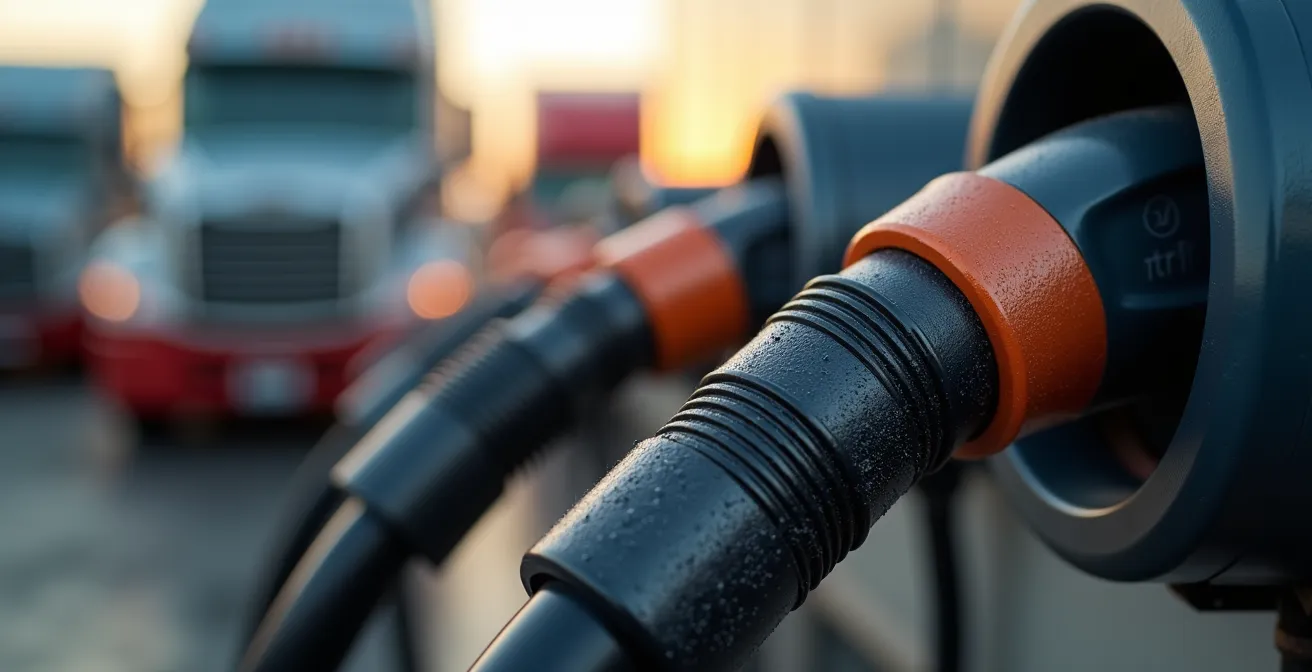
Think of your first EV trucks as a rolling laboratory. The goal of the pilot isn’t just to see if the truck works, but to gather critical data. You need to define your success metrics upfront: what is the real-world range with your typical loads? What are the driver training requirements? What are the differences in maintenance needs and costs? This data will be invaluable as you build your long-term fleet transition strategy, especially as the ATA estimates that 1.2 million new truck drivers will be needed in the next decade, making technology-driven efficiency a necessity.
How to negotiate Full Truckload road freight haulage rates when fuel costs spike?
When fuel prices spike, the traditional negotiation between a shipper and a carrier turns into a tense, zero-sum game. Shippers demand stable rates, while carriers face existential threats to their margins. A successful fleet manager knows this transactional tug-of-war is a losing proposition for both sides. The only way to win is to change the game entirely—by moving from a transactional relationship to a strategic partnership model.
The foundation of this partnership is transparency and shared risk. Instead of arguing over a fixed rate, you come to the table with data. By using your telematics, you can present a clear, all-in cost breakdown for specific lanes, including deadhead miles, driver wait times, and actual fuel consumption. This shifts the conversation from a generic “what’s your rate?” to a specific “here’s what it costs to do business on this lane, let’s build a fair price together.”
This transparency allows you to build more sophisticated rate structures. A key tool is a two-way, index-based fuel surcharge, tied to a public benchmark like the EIA’s weekly report. This means the rate adjusts fairly in both directions, protecting the carrier when fuel spikes and giving the shipper the benefit when it falls. By committing to dedicated capacity over a 6-12 month period, you provide the shipper with stability they can’t get on the spot market, and in return, you secure a predictable revenue stream that insulates you from volatility. This turns a contentious negotiation into a collaborative planning session.
The table below outlines the shift from a traditional, confrontational approach to a modern, partnership-based model that fosters long-term stability.
| Negotiation Strategy | Traditional Approach | Partnership Model |
|---|---|---|
| Fuel Adjustment | One-way surcharge only | Two-way index-based formula (EIA weekly) |
| Rate Structure | Spot market pricing | 6-12 month fixed capacity commitment |
| Non-Monetary Terms | Standard terms | Flexible windows, faster payment |
| Risk Distribution | Carrier bears all risk | Shared volatility protection |
| Customer Relationship | Transactional | Strategic partnership |
How to implement a predictive vehicle maintenance program to reduce breakdowns?
The old model of maintenance was simple: wait for a driver to report a problem or follow the manufacturer’s recommended service intervals. This is a purely reactive approach that guarantees two things: unexpected downtime and higher costs. A modern, successful fleet manager acts as a proactive risk manager, using data to anticipate failures before they happen. This is the essence of a predictive vehicle maintenance program, and it’s one of the most powerful levers you have to improve efficiency and reliability.
Implementing a full-scale predictive program can seem daunting, so the key is to start small and demonstrate quick wins. Don’t try to predict everything at once. Begin by focusing on 2-3 high-frequency, high-impact failure components. For most fleets, this means batteries, tires, and alternators. By integrating your existing data streams—telematics fault codes, driver vehicle inspection reports (DVIRs), fuel consumption trends, and repair histories—you can start to identify the subtle warning signs that precede a failure.
The goal is to create a “Predictive Triage” system. Instead of a simple “check engine light,” your system should generate intelligent alerts: “inspect at next scheduled PM,” “requires attention within 48 hours,” or “immediate action required.” Crucially, you must involve your senior technicians in setting the parameters for these alerts. Their experience and buy-in are essential for the system’s accuracy and acceptance by the maintenance team. Fleets that master this data-driven approach often report significant gains, with some seeing operational cost reductions of up to 18% through optimized maintenance and operations.
Your Action Plan: Phased Predictive Maintenance Rollout
- Target Quick Wins: Start by focusing data analysis on just 2-3 high-frequency failure components like batteries, tires, or alternators to demonstrate ROI.
- Consolidate Data Streams: Inventory and integrate all existing data sources—telematics fault codes, DVIRs, fuel data, and repair history—into a single view for analysis.
- Establish Triage Rules: Work with senior technicians to define alert categories (e.g., ‘Inspect at next PM’, ’48-hour attention’, ‘Immediate action’) to build trust and prioritize work effectively.
- Analyze Operational Patterns: Use analytics to find correlations between vehicle issues and operational factors like excessive idling or specific inefficient routes.
- Build Your Dashboard: Implement customizable dashboards to track key maintenance KPIs, monitor alert trends, and measure progress toward breakdown reduction goals.
Key Takeaways
- The driver shortage is a leadership challenge, not just a wage problem. The focus must shift from recruitment to retention.
- Technology is a tool to empower people and build culture, not just to monitor assets. Use it to create partnerships, not surveillance.
- Proactive risk management—in maintenance, finance, and regulation—is the defining characteristic of a successful modern fleet manager.
How to prepare for upcoming environmental mandates impacting diesel fleets?
For many fleet managers, environmental regulations from bodies like the EPA or CARB feel like a storm on the horizon—a costly, complex threat to be dealt with when it arrives. A proactive leader, however, sees it differently. They view the regulatory landscape not as a threat, but as an opportunity to build a more efficient, modern, and competitive fleet. The key is to have a “Regulatory Radar” always on, allowing you to plan years ahead instead of reacting at the last minute.
The first step is to map your entire operational footprint against both current and proposed regulations. Where are the Low Emission Zones? Which states are adopting stricter standards? This map allows you to build compliance directly into your fleet replacement cycle. Instead of being forced into a fire sale of non-compliant trucks, you strategically retire your oldest, dirtiest assets in the most regulated areas first. This planned, proactive approach has a much better ROI than a reactive, forced modernization.
This strategy does more than just ensure compliance; it creates a marketable competitive advantage. By investing in bridge technologies like renewable natural gas, advanced biofuels, or the latest clean diesel models, you can build a “Green Fleet” capability. This is a powerful selling point for ESG-conscious customers, who are increasingly willing to pay a premium and grant preferred partner status to carriers who can help them meet their own sustainability goals. You transform a compliance cost into a revenue opportunity.
The road ahead is challenging, but the path to success is clear. By embracing your role as a talent steward and a proactive risk manager, you can build a resilient, profitable, and respected fleet that attracts and retains the best talent. Start today by choosing one area—whether it’s building a shared savings program or mapping your regulatory risks—and take the first step toward transforming your leadership and your fleet’s future.