
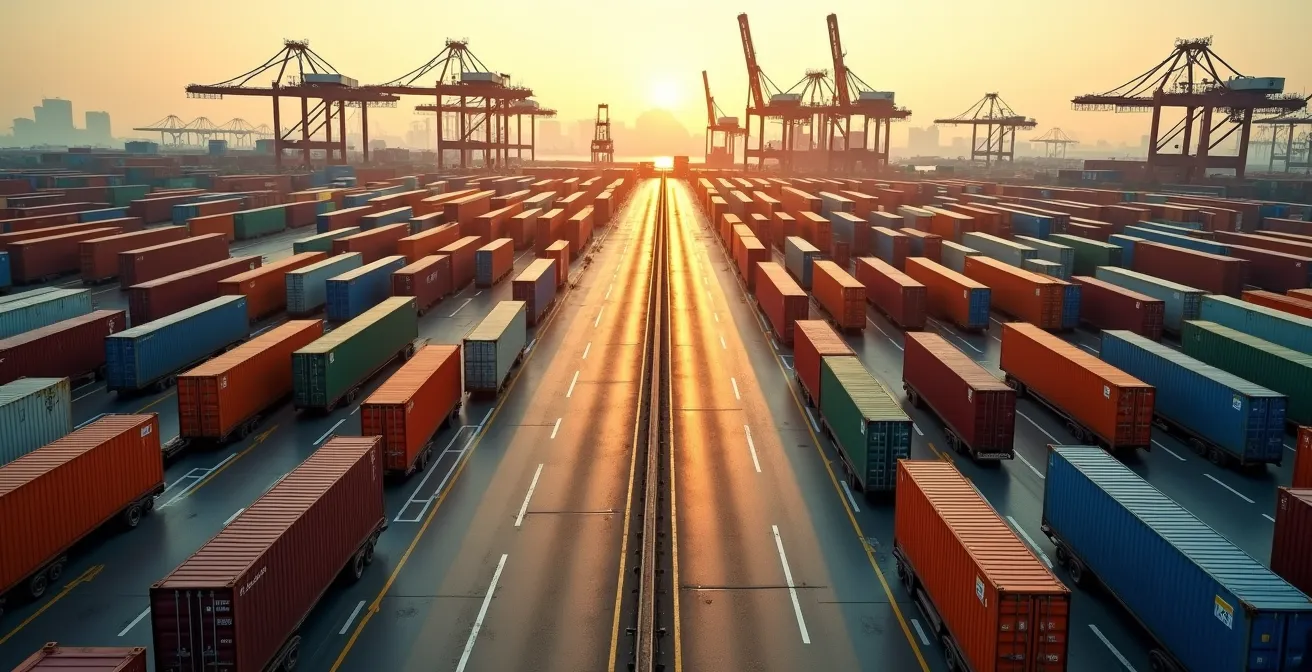
Detention fees are not a random cost of doing business; they are a direct result of predictable system failures within freight terminals. This guide moves beyond generic advice, offering a terminal operations manager’s playbook on how to understand and exploit these inefficiencies. By treating the terminal as a system with exploitable rules—from outdated software to appointment slot patterns—dispatchers can systematically bypass bottlenecks, optimize turn times, and eliminate detention charges from their P&L.
As a dispatcher, you know the feeling all too well. Your driver calls in, stuck. They’ve been idling for an hour at the terminal gate, the clock is ticking, and a profitable run is quickly turning into a loss leader thanks to impending detention charges. You’ve been told to “plan better” or “communicate more,” but this advice feels hollow when you’re at the mercy of a congested port or a backed-up rail ramp. The conventional wisdom about managing terminal interactions is fundamentally flawed because it treats congestion as an unpredictable act of nature.
The reality is far different. From my perspective managing terminal operations, congestion is a series of predictable bottlenecks. It’s a system, and like any system, it has rules, weaknesses, and patterns. The key to eliminating detention isn’t about working harder; it’s about working smarter by understanding the terminal’s internal logic. What if the true leverage isn’t in pleading with a clerk, but in knowing precisely when appointment slots are cancelled and automatically grabbing them? What if the choice between a wheeled or grounded container isn’t just a minor detail, but a strategic decision that can cut pickup time by two-thirds?
This guide will deconstruct the terminal environment from the inside out. We will move past the platitudes and into the mechanics of terminal operations. You will learn to identify the operational friction points that create delays and execute specific, data-driven strategies to navigate them. We’ll cover how to exploit outdated systems, master appointment scheduling, make critical operational choices, and use analytics to transform your dispatch function from reactive to predictive. It’s time to stop paying for someone else’s inefficiency.
In the following sections, we will break down the specific strategies and operational knowledge you need to master terminal flow. This framework is designed to give you, the dispatcher, the control you need to protect your drivers’ time and your company’s bottom line.
Summary: A Dispatcher’s Guide to Eliminating Terminal Detention Fees
- Why your driver waits 2 hours because the Terminal Operating System is outdated?
- How to hack the terminal appointment system to get slots during peak hours?
- Wheeled vs Grounded terminal operations: Which allows for faster pick-up?
- The safety vest error that gets drivers banned from major terminals for life
- How to utilize night gates to double your daily container turns?
- How to reduce transit time by 3 days without upgrading to air freight?
- How to optimize flow through intermodal logistics to reduce carbon footprint by 20%?
- How to predict accurate arrival times for sensitive shipments using predictive analytics?
Why your driver waits 2 hours because the Terminal Operating System is outdated?
The Terminal Operating System (TOS) is the central nervous system of any port or rail ramp, but for many facilities, it’s also the single greatest point of operational friction. When your driver reports a “system down” error, it’s often not a complete outage. More frequently, it’s a failure at a specific chokepoint, like the Optical Character Recognition (OCR) at the gate, a data mismatch between the TOS and a shipping line’s database, or a system timeout during peak processing. These are not random events; they are symptoms of aging, poorly integrated software.
From an operational standpoint, these legacy systems cannot handle the data velocity of modern logistics. They lack the real-time API integrations necessary to seamlessly verify appointments, container status, and driver credentials. This forces terminal staff into manual overrides and exception handling, which is the direct cause of the long queues your drivers endure. Instead of viewing this as an unavoidable delay, you must treat it as a data collection and dispute opportunity. A driver armed with a clear protocol to document these specific failures is no longer a victim; they are an agent collecting evidence to waive detention fees.
A successful case study at several chemical complex terminals shows that direct API integration can bypass these faulty public-facing TOS interfaces entirely. By synchronizing data directly between carrier and terminal systems, the project reduced gate processing time by 40%, proving that the bottleneck is the interface, not the physical capacity. As a dispatcher, your goal is to have a process that proves your driver was ready and the terminal’s system was the point of failure.
Action Plan: TOS Failure Documentation for Detention Disputes
- Isolate the Error: Instruct the driver to document the specific error type. Is it an OCR failure on the container number, a “no appointment found” message on the kiosk, or a system timeout? Capture time-stamped photos of any error screens.
- Document Inaction: Record GPS data showing a stationary position at the gate or in a queue. Note the badge numbers and interaction times with any terminal staff who are unable to resolve the issue.
- Initiate Escalation Protocol: If the delay at the gate due to a documented system error exceeds 30 minutes, the driver must contact you, and you must contact the terminal operations manager or designated help desk. Note the time and outcome of this call.
- Verify Evidence Integrity: Before the driver leaves the terminal, confirm all photographic evidence is clear, time-stamped, and captures the essential details (container number, error message, location).
- File the Dispute Immediately: Submit a formal detention dispute with the full evidence package within 24 hours. The claim should clearly state “Delay due to documented terminal system failure” and attach all supporting photos and logs.
This structured approach transforms a frustrating delay into a non-billable event, shifting financial responsibility from your company back to the terminal where it belongs.
How to hack the terminal appointment system to get slots during peak hours?
Terminal appointment systems are not a lottery; they are a marketplace governed by predictable patterns of supply and demand. “Hacking” these systems does not mean illicit activity. It means applying systematic, data-driven strategies to secure slots when others cannot. The majority of dispatchers operate on a first-come, first-served basis, reacting to available slots. A strategic operator analyzes the system itself to anticipate availability. This approach requires a shift in mindset from passive booking to active “system arbitrage.”
The first step is understanding cancellation patterns. Most terminals see a wave of appointment cancellations in the middle of the night, typically between 2 AM and 4 AM local time, as carriers release slots they cannot fill. Manually checking at these hours is inefficient. The solution is to deploy automated booking tools or scripts that leverage the terminal’s API. These tools can monitor for newly released slots and secure them within seconds, far faster than any human. This single strategy can be the difference between securing a peak-hour appointment and settling for an off-peak time that ruins your driver’s daily schedule.
Furthermore, isolated dispatchers are at a disadvantage. Forming “appointment pooling alliances” with a small group of 3-5 trusted carriers creates a private marketplace for trading slots. When one carrier has a driver fall off a load, the appointment can be immediately transferred to a partner in need, bypassing the public system entirely. This collaborative approach minimizes wasted slots and maximizes fleet utilization for all members. According to 2024 research, optimizing appointment strategies can lead to a 10.96% reduction in operational costs, a significant saving driven purely by scheduling intelligence.
This digital-first strategy is about turning the appointment system into a competitive advantage. The visual below represents this strategic approach, where each slot is a calculated move, not a game of chance.

By treating the appointment grid as a chessboard, dispatchers can plan moves in advance, control valuable positions (peak hours), and ultimately outmaneuver competitors who are still playing checkers. This proactive stance is fundamental to achieving high turn time velocity.
Ultimately, the goal is to make the system work for you, securing the most valuable appointments and ensuring your drivers are always moving during the most productive hours.
Wheeled vs Grounded terminal operations: Which allows for faster pick-up?
The decision between using a wheeled (container on chassis) or grounded (stacked container) terminal operation is one of the most critical, yet often overlooked, factors impacting driver turn time. The choice is not merely logistical; it’s a strategic trade-off between speed and cost. A dispatcher who understands the operational mechanics of each can save their driver up to an hour per turn. A wheeled operation, also known as “peel-off,” is built for speed. The container is already on a chassis, allowing the driver to hook up and leave with minimal terminal equipment interaction. This is ideal for high-volume, time-sensitive freight.
Conversely, a grounded operation requires a yard hustler or a rubber-tired gantry (RTG) crane to locate the container in a stack and mount it onto the driver’s chassis. This process introduces multiple points of potential delay: waiting for equipment, yard congestion, and the time it takes to dig a container out from a stack. While this method saves on chassis rental costs, that saving can be instantly erased by a single detention charge. A dispatcher must weigh the daily chassis cost against the high probability of detention in a congested, grounded yard.
An analysis of terminals with hybrid operations reveals a key insight: carriers that specialize in a specific operation type and match it to the correct terminal zone report 40% faster turn times. This means your job is not just to dispatch a driver, but to route them to the specific type of operation that best fits the day’s conditions and the shipment’s priority. A low-priority empty return might be perfect for a cost-effective grounded drop, while a hot live load demands a pre-vetted wheeled pickup. Ignoring this distinction means leaving efficiency on the table.
The following decision matrix breaks down the key operational differences. As revealed in a recent comparative analysis of terminal systems, the impact on turn time is stark and predictable.
| Factor | Wheeled Operations | Grounded Operations | Impact on Turn Time |
|---|---|---|---|
| Average Pick-up Time | 15-20 minutes | 45-60 minutes | Wheeled 3x faster |
| Chassis Rental Cost | $0 (on chassis) | $75-150/day saved | Cost vs. speed trade-off |
| Empty Return Efficiency | Direct return possible | Additional chassis trip needed | +30 mins for grounded |
| Terminal Congestion Impact | Minimal waiting | Yard equipment dependent | Variable 0-120 mins |
| Driver Specialization Required | Standard CDL | Yard equipment knowledge | Training impacts efficiency |
Making the correct choice requires real-time knowledge of terminal conditions, but as a rule, if the risk of detention is moderate to high, the speed and predictability of a wheeled operation will almost always deliver a better financial outcome.
The safety vest error that gets drivers banned from major terminals for life
While dispatchers focus on appointments and container numbers, a simple Personal Protective Equipment (PPE) violation can have catastrophic consequences. The “safety vest error” is not about a driver forgetting their vest; it’s about failing to meet the exact, and often changing, specifications of a particular terminal. One terminal may require an ANSI Class 2 vest, while another, just a mile away, mandates a Class 3 five-point breakaway vest. A driver showing up with the wrong type is not just turned away; they are often cited for a safety violation. Multiple citations can lead to a permanent ban from that terminal operator’s facilities nationwide.
For a carrier, a banned driver is a significant financial blow. The immediate impact includes lost revenue and the cost of recruiting and training a replacement. More critically, it damages the carrier’s reputation and safety score, potentially affecting insurance premiums and shipper relationships. An industry analysis reveals a total cost per banned driver can range from $50,000 to $75,000 when all factors are considered. This is a staggering price to pay for what is often a preventable compliance failure.
The responsibility for preventing this falls squarely on the dispatcher. It’s your job to ensure that PPE compliance is treated with the same seriousness as HOS rules or dispatch instructions. This requires a systematic approach, not just a verbal reminder. Successful carriers implement a “Terminal Compliance Card” system. For each terminal your company services, you should maintain a digital or physical card that lists the precise PPE requirements: vest class, hard hat color, specific type of safety glasses, etc. This information should be reviewed monthly against terminal bulletins and pushed to drivers’ mobile devices before they arrive.
Implementing geofencing alerts on driver apps that trigger a PPE checklist upon approaching a terminal is another effective tactic. Before entering the gate, the driver must run through the checklist and even take a photo of their equipment. This creates a culture of compliance and provides a documented record that the driver was prepared correctly before entry. This isn’t micromanagement; it’s risk mitigation for a high-stakes operational detail that can ground a truck and a career for life.
Ultimately, a driver is an extension of your company’s safety culture. Ensuring they have the right gear for every single terminal is a core function of an efficient and professional dispatch operation.
How to utilize night gates to double your daily container turns?
For most carriers, night gates are a reluctant alternative used only when day shifts are impossible. This is a strategic error. For the proactive dispatcher, off-peak hours and night gates are a primary tool for maximizing productivity and achieving superior turn time velocity. While day shifts are characterized by congestion, long queues, and high detention risk, night shifts offer an environment of near-zero traffic, immediate gate access, and abundant equipment availability. The ability to consistently complete a turn in under an hour, as opposed to the two-to-three hours common during the day, fundamentally changes a driver’s daily earning potential.
A 2024 case study on the Port of Los Angeles’ 24/7 gate operations provides clear evidence: carriers that built their schedules around night gates reported doubling their daily container turns, moving from an average of 3 to 6 trips per driver. This dramatic increase in productivity was achieved even after accounting for a 15% average increase in driver wages for the night shift. The program also led to a staggering 3.7-day reduction in average container dwell time, providing immense value to shippers.
The key is to perform a clear-eyed Return on Investment (ROI) analysis. The higher hourly pay for a night shift driver is often the only metric considered, leading to a false conclusion that it’s too expensive. However, a proper analysis must factor in the significant cost savings. These include the near-elimination of detention charges, drastically reduced fuel consumption from idling in queues, and lower maintenance costs due to less wear-and-tear. When these savings are combined with the revenue from doubling the number of turns, the financial case for a night-gate-centric strategy becomes undeniable.
This table illustrates the variables that must be included in a proper night gate ROI calculation, showing how increased productivity and cost avoidance far outweigh the increase in driver pay.
| Cost Factor | Day Shift | Night Shift | Net Impact |
|---|---|---|---|
| Driver Pay Rate | $28/hour | $35/hour (+25%) | +$56/shift |
| Fuel Cost (Idling) | $45/trip | $15/trip | -$30/trip |
| Container Turns | 3/day | 6/day | +100% productivity |
| Detention Risk | High (30%) | Low (5%) | -$200/day saved |
| Customer Value | Standard | Premium service | +15% rate potential |
By shifting a portion of your fleet to a dedicated night schedule, you are not just avoiding traffic; you are creating a new, highly profitable operational model that your competitors are likely ignoring.
How to reduce transit time by 3 days without upgrading to air freight?
For a shipper, total transit time is the only metric that matters. As a dispatcher, your ability to influence this metric extends far beyond simply booking a driver. Significant time savings are often found not on the road, but in compressing the time a container sits idle at the terminal—a period known as dwell time. By aggressively managing every step of the port-to-road transition, you can shave days off a delivery schedule, providing a premium service without the prohibitive cost of air freight.
The process begins before the vessel even docks. Utilizing advance manifest data to pre-clear customs 5 to 7 days before arrival is the single most effective way to reduce dwell time. A container that arrives “cleared” can be discharged and made available for pickup immediately, while one awaiting clearance can sit for days. This step alone can save 24-48 hours. The next step is to invest in priority services. Paying a fee for “priority discharge” ensures your container is one of the first off the vessel. This small investment can be invaluable for time-sensitive cargo.
Routing strategy is another powerful lever. Instead of automatically using the closest major port, analyze congestion data to identify less-congested secondary ports. While the inland transit might be slightly longer, the time saved by avoiding terminal gridlock can be substantial. For instance, 2024 port congestion data shows an average delay of 3.7 days at the Port of Los Angeles, compared to just 1.2 days at smaller, more efficient regional ports. A two-day saving at the port more than compensates for a few extra hours on the highway.
Finally, the pickup itself must be flawlessly executed. This means having a dedicated drayage contract with a guaranteed pickup within a few hours of the container becoming available and pre-arranging cross-docking facility space so the container can be immediately transloaded. Each step is a link in the chain; a failure in one negates the efficiency gained in the others. This end-to-end management of dwell time is a high-value skill that separates an average dispatcher from a top-tier logistics coordinator.
By orchestrating these elements, you are not just moving a box; you are actively engineering a faster supply chain and creating a significant competitive advantage for your company and your customers.
How to optimize flow through intermodal logistics to reduce carbon footprint by 20%?
In today’s market, sustainability is not just an ethical consideration; it’s a key performance indicator for many shippers. Optimizing intermodal logistics offers a powerful way to meet these demands, allowing you to reduce a shipment’s carbon footprint by over 20% while often maintaining competitive transit times. The key is to understand the “carbon tipping point”—the distance at which shifting from a pure truckload move to a rail-and-truck combination becomes more environmentally and economically efficient.
For short-haul drayage, trucking remains superior. However, as the total distance increases, the efficiency of rail becomes dominant. The carbon tipping point typically occurs at around 180-250 miles. Beyond this distance, every mile the container travels by rail instead of by truck significantly lowers its overall CO2 emissions. Your role as a dispatcher is to identify these opportunities in your network. Instead of defaulting to a long-haul truck for a 400-mile journey, you should be quoting and planning an intermodal route: a short dray to the rail ramp, the long journey by train, and a final short dray to the destination.
The Virginia Inland Port provides a compelling model for this strategy. A case study on its operations demonstrated a 23% carbon footprint reduction by strategically shifting containers from a 220-mile truck drayage to an intermodal route. This was achieved by using rail for the long-haul portion and limiting truck drayage to the final 50 miles. This not only met the shipper’s green logistics goals but also freed up truck capacity for more profitable short-haul runs.
To effectively implement this, you must have a clear understanding of your network’s break-even points. An analysis comparing pure truck CO2 output to intermodal CO2 output by distance reveals a clear pattern: at 150 miles, trucks are often more efficient, but at 250 miles, intermodal gains a 21% carbon advantage, which grows to over 40% for moves of 600 miles or more. This data allows you to build a routing guide that automatically flags long-haul shipments as candidates for intermodal conversion. This transforms your dispatch function into a strategic partner that can help shippers achieve their sustainability targets.
By mastering intermodal optimization, you add a valuable service to your portfolio, making your company more attractive to a growing segment of environmentally conscious shippers while improving overall network efficiency.
Key Takeaways
- Treat terminals as systems with predictable flaws, not random chaos, to find and exploit inefficiencies.
- Proactive data analysis of appointment patterns and night gate ROI is more effective than reactive problem-solving.
- Every minute saved through strategic choices—like wheeled vs. grounded or customs pre-clearance—directly impacts profitability and transit time.
How to predict accurate arrival times for sensitive shipments using predictive analytics?
For sensitive, high-value shipments, a standard ETA is not enough. Shippers require a dynamic, accurate Estimated Time of Arrival (ETA) that accounts for real-time variables. This is where predictive analytics transforms the role of a dispatcher. Instead of simply relaying tracking information, you can provide a sophisticated forecast that anticipates delays before they happen. This is achieved by integrating multiple layers of data into a machine learning (ML) model that learns from historical performance.
A robust predictive ETA model goes far beyond a single GPS ping. It requires a multi-layer data integration framework. This includes real-time GPS data, port congestion indices derived from AIS vessel tracking, weather forecasts, and even real-time road traffic data from APIs. When you layer in warehouse appointment schedules and historical variance data, the model can start to identify complex patterns. It learns, for example, that a specific trade lane combined with a forecast of rain and peak-hour terminal traffic has a 75% probability of a 3-hour delay. As a result, advanced predictive analytics systems achieve an 85% accuracy rate within a five-hour window for long-haul shipments.
Visibility providers like FourKites have demonstrated the power of this approach. Their ML models can predict specific exceptions, such as a “70% chance of a customs hold,” based on the commodity type, origin country, and current port conditions. Crucially, these systems operate on a feedback loop. By comparing predicted ETAs with actual arrival times, the model continuously refines its algorithms, improving its accuracy over time. An implementation might start with 60% accuracy and reach 85% or higher within six months.
For a dispatcher, this technology is a game-changer. You are no longer just a messenger of bad news when a delay occurs. You become a risk manager, able to alert a customer of a probable delay days in advance and suggest alternative plans. This level of proactive service builds immense trust and customer loyalty. It allows the customer to adjust their labor schedules, manufacturing lines, or retail promotions, turning a potential supply chain disruption into a managed event. The investment in predictive analytics pays for itself through customer retention and the ability to command premium rates for a demonstrably superior service.
By embracing predictive analytics, you elevate your role from a simple coordinator to an indispensable logistics strategist, capable of delivering the certainty and reliability that modern supply chains demand.