
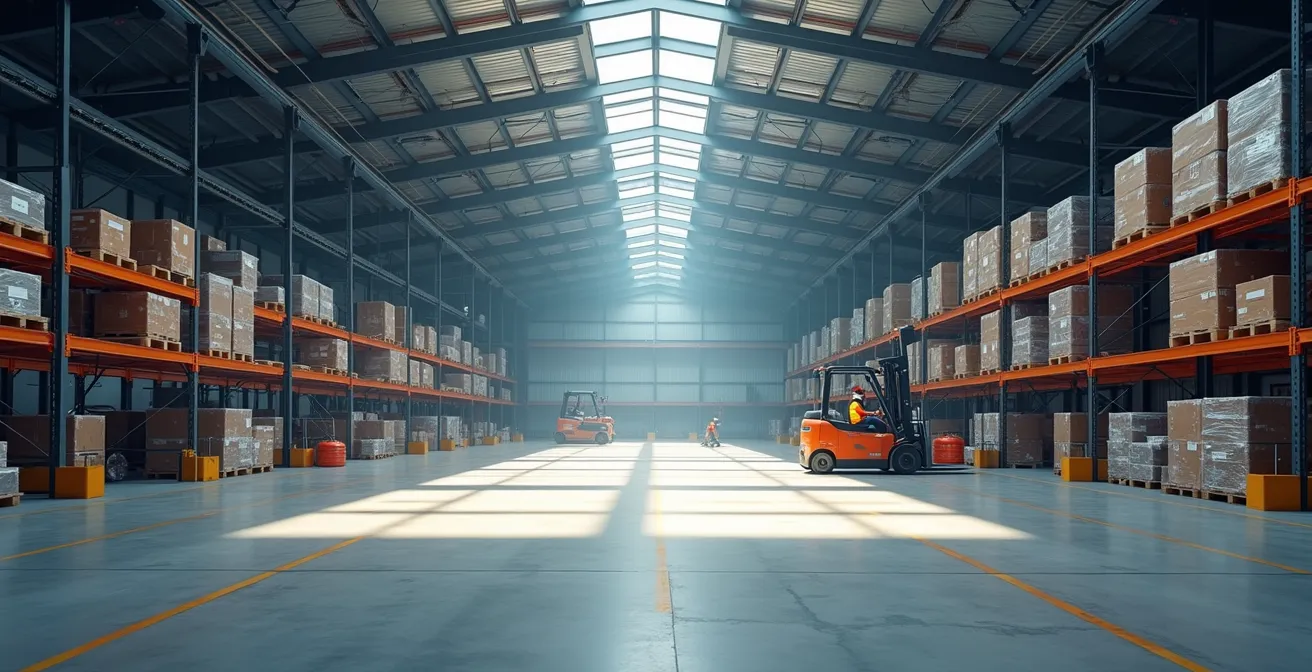
The debate over abandoning Just-in-Time (JIT) for Just-in-Case (JIC) is a false dichotomy; the future is a hybrid, risk-stratified model where lean principles are fortified with strategic buffers.
- Pure JIT creates extreme vulnerability to disruptions, imposing a hidden “brittleness tax” on operations during events like port strikes or supplier failures.
- A sophisticated approach involves segmenting components by risk and lead time, applying strict JIT for local/commodity parts while building strategic stockpiles for critical, long-lead-time imports.
Recommendation: Stop thinking in terms of “JIT vs. JIC” and start designing a “JIT-with-Firewalls” system that surgically applies lean efficiency while building robust resilience against predictable volatility.
For decades, Just-in-Time (JIT) has been the undisputed champion of manufacturing efficiency. As a Lean Six Sigma Master Black Belt, I’ve implemented and celebrated its power to slash inventory costs, reduce waste, and streamline production. The core promise was seductive: receive parts precisely when you need them, minimizing carrying costs and maximizing capital efficiency. For a stable, predictable global economy, it was a work of genius. But the world has changed. The smooth-sailing trade routes of the past have become a minefield of port strikes, geopolitical tensions, and unforeseen black swan events.
The common reaction has been a panicked call to abandon JIT entirely in favor of a simplistic “Just-in-Case” (JIC) model, essentially reverting to bloated, inefficient warehouses full of safety stock. This is a critical error in judgment. It treats the symptom—supply chain disruption—while ignoring the disease: a one-size-fits-all inventory strategy. The generic advice to “diversify suppliers” or “add safety stock” is insufficient for the complex challenges manufacturing directors face today. It lacks the strategic nuance required to balance lean principles with genuine supply chain security.
The truth is, JIT is not dead; it has been naively and incompletely applied. The core philosophy of eliminating waste is more relevant than ever. However, it must evolve. The way forward is not to discard JIT but to modify it into a sophisticated, hybrid system. This approach involves a critical, data-driven analysis of your supply chain to create what I call a risk-stratified inventory system. It’s a model where the ruthless efficiency of JIT is preserved for low-risk components, while strategic buffers, or “firewalls,” are intelligently built to protect production from high-risk vulnerabilities.
This article will deconstruct the failures of pure JIT in today’s economy and provide a constructive framework for its evolution. We will explore how to integrate suppliers more deeply, choose the right model for different production types, avoid critical sourcing mistakes, and ultimately realign your supply chain strategy for resilience, not just cost. It’s time to move beyond the binary debate and engineer a supply chain that is both lean and unbreakable.
For those who prefer a condensed format, the following video offers an expert discussion on the strategic shift from pure Just-in-Time towards more resilient operational models, perfectly complementing the detailed guide below.
This guide provides a structured path for manufacturing leaders to rethink their inventory strategy. We will dissect the vulnerabilities of traditional JIT and build a new, resilient framework piece by piece, starting with the fundamental financial risks.
Summary: A strategic framework for evolving JIT in a volatile world
- Why JIT saves money today but bankrupts companies during port strikes?
- How to integrate supplier staff into your facility to tighten JIT loops?
- Just-in-Time vs Just-in-Case: Which fits high-value, low-volume production?
- The sole-sourcing mistake that halts JIT production lines for weeks
- How to maintain JIT for local parts while stockpiling imported components?
- How to maintain continuous production flow when inbound raw materials are delayed?
- How to manage air cargo expediting costs when production lines are down?
- How to realign strategic management of global supply chains for resilience over cost?
Why JIT saves money today but bankrupts companies during port strikes?
The primary appeal of Just-in-Time is its immediate impact on the balance sheet. By minimizing inventory, companies reduce carrying costs—storage, insurance, obsolescence—and free up working capital. In a stable environment, this is pure financial gain. However, this hyper-efficiency creates extreme fragility. A pure JIT system has zero tolerance for variance. When a critical node in the supply chain fails, like a major port shutting down, the production line grinds to a halt within days, sometimes hours. This is the core weakness of JIT: it optimizes for the best-case scenario, leaving no buffer for the inevitable disruptions of a fragile global economy.
The costs associated with this fragility are what I term the “Brittleness Tax.” It’s a hidden liability that doesn’t appear on any financial statement until a crisis hits. Consider the massive breakdown during the 2024 U.S. East and Gulf Coast port strikes, where 36 ports were shut down by nearly 45,000 striking dockworkers. For a company reliant on JIT for imported components, this wasn’t an inconvenience; it was a catastrophic failure. The savings from years of lean inventory were wiped out in a matter of weeks by idled production lines, missed delivery penalties, and lost customer trust.
Recent data confirms this trend, with Resilinc’s 2024 analysis showing a 38% year-over-year increase in disruptions, a majority of which required significant intervention. The fallacy is assuming these events are rare. They are the new normal. The “Brittleness Tax” is composed of second-order costs: premium rates for expedited air freight, the high price of spot-buying components from alternate suppliers, and the long-term damage to market share when you can’t deliver. The calculus is no longer about minimizing carrying costs but about balancing them against the catastrophic cost of a line-down situation.
How to integrate supplier staff into your facility to tighten JIT loops?
One of the most powerful, yet underutilized, methods to strengthen a JIT system is to move beyond transactional relationships and toward deep operational integration. This involves embedding key supplier personnel directly into your facility. This is not simply co-location; it’s a fundamental shift in information sharing, decision-making, and problem-solving. When a supplier’s inventory manager or quality engineer is physically present on your production floor, the communication loop tightens from days or hours to mere minutes. They gain real-time visibility into your production rhythm, consumption patterns, and potential bottlenecks.
This model allows for a more dynamic and responsive form of Vendor-Managed Inventory (VMI). The embedded supplier team can make immediate replenishment decisions based on live data, not on delayed EDI transmissions or weekly forecasts. This is a core principle behind the legendary Toyota Production System. The partnership between Toyota and its key supplier, Denso, has exemplified this since the 1980s. Denso staff manage their component inventory directly within Toyota plants, using Kanban signals and direct access to production schedules to ensure a seamless flow, effectively becoming an extension of Toyota’s own team.
This illustration highlights the collaborative workspace, where teams from different companies work as one cohesive unit to solve problems in real-time.

As you can see, this shared environment breaks down the traditional “us vs. them” barrier. The supplier isn’t just a vendor; they are a partner vested in your success. They can proactively identify issues—a dip in quality, a pending shortage—and address them before they halt production. This level of integration transforms the supplier relationship from a point of potential failure to a source of competitive advantage and resilience.
The following table, based on models like Toyota’s, starkly contrasts the traditional arm’s-length approach with the deeply integrated embedded supplier model, demonstrating a clear superiority in responsiveness and risk visibility.
| Aspect | Traditional Supplier | Embedded Supplier Model |
|---|---|---|
| Information Sharing | Weekly/Monthly EDI transmissions | Real-time production data access |
| Decision Authority | Purchase orders only | Direct replenishment decisions |
| Physical Presence | External deliveries | On-site inventory management |
| Risk Visibility | Tier 1 only | Tier 2-3 supply chain insights |
| Response Time | 24-48 hours | 2-4 hours |
Just-in-Time vs Just-in-Case: Which fits high-value, low-volume production?
The debate between JIT and JIC is often oversimplified. The correct approach is not a universal choice but a strategic one, highly dependent on the production environment. For high-volume, low-mix commodity manufacturing, the cost savings of a pure JIT system can be substantial, assuming a stable supply base. However, for high-value, low-volume production—common in aerospace, medical devices, or custom industrial machinery—the calculus changes dramatically. Here, the cost of a single line-down event due to a missing component can dwarf a year’s worth of inventory carrying costs.
In this context, a pure JIT model is an unacceptable gamble. The solution is not a complete swing to a bloated JIC system either, but a hybrid strategy known as postponement or strategic decoupling. This involves holding inventory not as finished goods, but as standardized, semi-finished components. The final customization, the most value-adding step, is “postponed” until a firm customer order is received. This allows you to buffer against supply chain volatility for common base materials (a JIC characteristic) while maintaining the flexibility and waste reduction of JIT for the final assembly process.
This approach counters the notion that JIT and resilience are mutually exclusive. As Thomas Y. Choi and his colleagues argue in a recent journal article, the principles of JIT can actually build resilience when implemented correctly. They state:
We need more JIT, not less, to build resilience in supply chains for performance. If adequately implemented, JIT creates a close relationship between suppliers and buyers who collaborate regularly and have digital technologies that allow communication and visibility.
– Thomas Y. Choi et al., Production and Operations Management Society Journal
Their point is crucial: the collaborative aspects of a mature JIT system are themselves a form of resilience. For high-value production, the answer is to pair this JIT-driven collaboration with strategic inventory decoupling points. You hold buffers of the “Lego bricks,” not the finished “Lego castle.”
The sole-sourcing mistake that halts JIT production lines for weeks
One of the most common and devastating errors in a JIT strategy is over-reliance on a single supplier, especially for a critical component. While sole-sourcing can offer economies of scale and simplify relationship management, it creates a single point of failure that can paralyze an entire organization. When that one supplier faces a factory fire, a labor strike, a quality control crisis, or geopolitical turmoil, your production line stops. There is no alternative. The scramble to qualify a new supplier takes weeks, if not months, during which time your facility is idle and your market share is eroding.
The increasing frequency of these events makes sole-sourcing a high-stakes gamble. For instance, recent analysis from Resilinc highlights a 47% year-over-year increase in labor disruptions, including major port and factory strikes that can instantly sever a sole-sourced supply line. The prudent strategy, therefore, is strategic dual-sourcing or multi-sourcing. This doesn’t mean abandoning the benefits of a primary supplier relationship. It means having a pre-qualified, “warm” secondary supplier who receives a small but steady stream of orders (e.g., an 80/20 split). This keeps them familiar with your specifications and processes, ready to ramp up production immediately when a disruption hits your primary source.
This strategic diversification is not just a theoretical concept; it’s a core component of how sophisticated companies like Toyota build resilience. After the catastrophic 2011 earthquake and tsunami in Japan, Toyota re-engineered its supply chain to systematically reduce sole-sourcing dependencies for critical components. They invested heavily in mapping their entire supply network, down to Tier 2 and Tier 3 suppliers, to identify and mitigate these concentration risks.

This visualization represents the goal: a distributed, resilient network, not a fragile chain. By mapping your supplier network geographically and by dependency, you can proactively identify concentration risks. The cost of maintaining a secondary supplier is not an expense; it’s an insurance policy against a multi-million-dollar production shutdown. It’s a fundamental shift from viewing suppliers as a cost to be minimized to a risk to be managed.
How to maintain JIT for local parts while stockpiling imported components?
This is the central question in evolving JIT for the modern economy. The answer lies in rejecting a one-size-fits-all inventory policy and implementing a two-tier or multi-tier inventory system. This risk-stratified approach treats components differently based on their specific risk profile, primarily determined by lead time, lead time variability, and geographic origin. It’s the practical application of the “JIT-with-Firewalls” concept.
Under this model, you segment your Bill of Materials (BOM) into distinct categories:
- Tier 1 (Local/Low-Risk): These are components sourced from local or regional suppliers with short, reliable lead times (e.g., <100km). For these parts, a strict JIT or Kanban system remains the optimal strategy. The risk of disruption is low, and the benefits of minimal inventory are high.
- Tier 2 (National/Medium-Risk): Components from national suppliers with moderately longer lead times. A hybrid Min/Max system is appropriate here, with a small safety stock (e.g., 3-5 days) to buffer against minor transport delays.
- Tier 3 (International/High-Risk): This category includes critical components imported via ocean freight with long and highly variable lead times (30+ days). These are your biggest vulnerabilities. For these parts, JIT is abandoned in favor of a strategic JIC/MRP approach, maintaining significant buffer stock (e.g., 30-60 days) to decouple your production from port strikes, customs delays, and international crises.
The following table provides a clear framework for this two-tier system, defining management methods and safety stock levels based on component origin and risk.
| Component Type | Management Method | Reorder Trigger | Safety Stock Level |
|---|---|---|---|
| Local Parts (<100km) | Kanban/JIT | Visual signal | 0.5-1 day supply |
| Regional Parts (100-500km) | Hybrid | Min/Max levels | 3-5 day supply |
| International Maritime | JIC/MRP | Economic forecast | 30-45 day supply |
| Critical Electronics | Strategic Stock | Quarterly review | 60-90 day supply |
Implementing this requires a rigorous financial analysis to determine not just the landed cost of a product, but its landed cost of risk. This calculation must factor in the probability and financial impact of a disruption for each high-risk component.
Your action plan: Landed Cost of Risk Calculation Framework
- Calculate base landed cost: product + freight + duties + handling.
- Add risk premium: (probability of disruption × days of disruption × daily revenue loss).
- Factor in storage costs: warehouse space + insurance + obsolescence risk.
- Compare total risk-adjusted cost vs. expedited shipping costs during disruptions.
- Set trigger points: when risk cost exceeds 15% of product value, shift to buffer stock.
How to maintain continuous production flow when inbound raw materials are delayed?
Even with a perfectly designed risk-stratified inventory system, delays will happen. The next layer of resilience is building operational flexibility to manage variability when it occurs. The goal is to absorb the shock of a delayed shipment without bringing the entire production facility to a standstill. This requires a combination of classic lean principles and modern digital tools.
A foundational concept from the Toyota Production System is Heijunka, or production leveling. Instead of producing large batches of a single product, Heijunka involves producing a smaller mix of different products every day. This creates a more stable and predictable demand signal for your suppliers and, more importantly, reduces your immediate dependency on any single raw material. If a component for Product A is delayed, you can dynamically re-sequence the production schedule to prioritize Products B and C, for which you have materials on hand. It turns a potential line-down event into a simple scheduling adjustment.
This principle is supercharged by modern technology. As Pawan Joshi, an executive at e2open, notes, technology is key to managing these dynamics:
AI-powered demand sensing offers precise forecasting for optimal inventory allocation across channels and locations based on real-time demand indicators.
– Pawan Joshi, EVP of Products & Strategy at e2open
This AI-driven visibility is crucial. When your systems can detect a delay in real-time and your scheduling software can automatically re-sequence production based on a pre-defined profitability matrix and material availability, you create an incredibly agile response mechanism. This dynamic production rescheduling capability allows the factory floor to pivot within hours, not days. The protocol involves having pre-qualified material substitutions, understanding the margin contribution of each product, and maintaining a “floating capacity” of 15-20% that can be reallocated on the fly. This turns your production line from a rigid, brittle system into a flexible, adaptive organism.
How to manage air cargo expediting costs when production lines are down?
When a critical component is delayed and a production line is down, the pressure to expedite is immense. The default reaction is often to authorize emergency air freight without a clear financial analysis. This can lead to staggering costs that erase any savings from JIT. Managing these costs requires a disciplined, data-driven framework to evaluate the break-even point for different expediting options. Not all line-down situations are created equal, and the response should be proportional to the financial impact.
The first step is to quantify the cost of doing nothing. What is the precise financial loss for every hour the production line is idle? This includes lost revenue, labor costs for idle workers, potential contract penalties, and the long-term cost of customer dissatisfaction. This hourly “line-down cost” becomes the benchmark against which all expediting options are measured. With a clear view that industry analysis shows that for every day of a strike, four to six days are needed to clear the subsequent backlog, the cost of inaction can quickly spiral.
The second step is to have a pre-vetted menu of expediting options with clear cost premiums and lead times. This isn’t something to scramble for during a crisis; it should be part of your standard logistics playbook. The options range from a small premium for priority ocean freight to the massive expense of a dedicated charter flight. Each has a different break-even point based on your line-down cost.
The following break-even analysis provides a critical decision-making tool. It helps a manufacturing director make a rational, financial decision under pressure, rather than a purely emotional one.
| Expediting Option | Cost Premium | Lead Time | Break-Even Point (Line Down Hours) |
|---|---|---|---|
| Standard Ocean | Baseline | 30-45 days | N/A |
| Premium Ocean | +20-30% | 20-25 days | 72 hours |
| Sea-Air Combined | +100-150% | 10-15 days | 48 hours |
| Full Air Freight | +300-500% | 2-3 days | 24 hours |
| Charter Flight | +800-1200% | 24 hours | 8 hours |
For example, if your line-down cost is extremely high, paying an 800% premium for a charter flight that gets you operational in 24 hours might be the most financially sound decision. Conversely, for a less critical line, waiting an extra week for premium ocean freight might be the correct call. This framework replaces panic with process.
Key takeaways
- The “JIT vs. JIC” debate is obsolete; a hybrid, risk-stratified inventory model is the only viable path forward.
- Extreme leanness creates a “brittleness tax”—the hidden cost of disruption that can erase years of JIT savings in a single event.
- Resilience is built by segmenting components: apply strict JIT to low-risk local parts and build strategic buffers for high-risk, long-lead-time imports.
How to realign strategic management of global supply chains for resilience over cost?
The final and most critical step is to elevate the conversation from the factory floor to the boardroom. The shift from a cost-only focus to a resilience-first mindset is a strategic one that must be driven from the top down. For years, supply chain managers have been primarily incentivized on one metric: inventory reduction. This singular focus has, as predicted, created immense fragility across entire industries.
As Wharton Professor Gad Allon powerfully states, the root of the problem is misaligned incentives:
The issue is that the moment you tell people their main objective is reducing inventory, and point all key performance indicators towards that goal, lean becomes their north star. And when lean is the north star, it creates unprecedented levels of unpreparedness.
– Gad Allon, Wharton Professor and Director of Jerome Fisher Program
To correct this, leadership must introduce and champion a new set of Resilience KPIs that are given equal weight to traditional cost metrics. The C-suite dashboard must evolve. Alongside metrics like Inventory Turns and Carrying Costs, there must be metrics like Time-to-Recover (TTR)—the time it takes to restore full production after a critical supplier is lost. Other key resilience metrics include a Supplier Dependency Index, which quantifies the risk associated with any single supplier, and the financial impact of simulated “disruption drills.”
This requires creating a new role or empowering an existing one, such as a Chief Supply Chain Risk Officer, with the authority to enforce these standards across procurement, logistics, and operations. Their mandate is not just to cut costs but to build a robust, adaptive supply network. This includes diversifying suppliers, qualifying alternative shipping modes, and investing in visibility platforms that can model the impact of a potential disruption before it happens. This strategic realignment reframes resilience not as a cost center, but as a critical investment in business continuity and a source of durable competitive advantage.
To begin implementing these principles, the next logical step is to conduct a formal risk-stratification audit of your current bill of materials and supplier network. Evaluate your components and partners through the lens of resilience, not just cost, to build a supply chain that is truly prepared for the economy of tomorrow.