
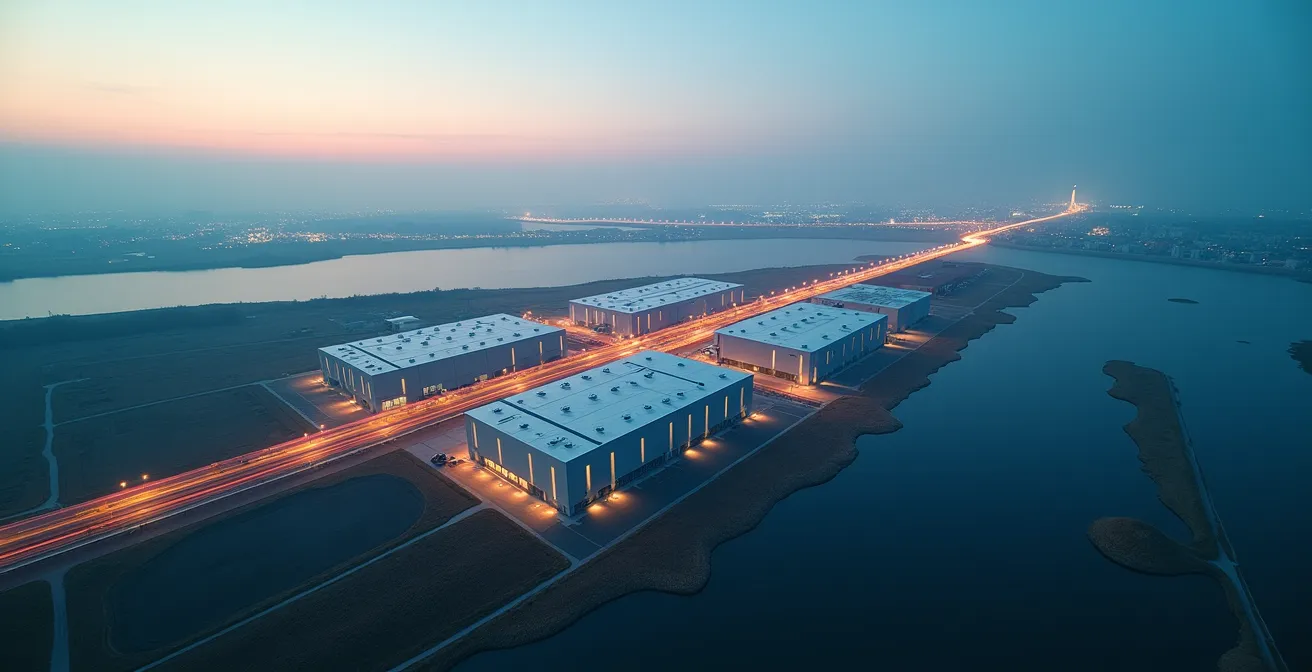
The era of the hyper-globalized, cost-obsessed supply chain is over; the future belongs to strategists who can build and manage resilient, regional ecosystems.
- Geopolitical shifts and economic pressures are forcing a retreat from global dependencies toward consolidated regional trade blocs.
- This new paradigm demands a fundamental mindset shift from “efficiency-first” to “resilience-first,” treating uptime and adaptability as primary value drivers.
- Ignoring new regulatory complexities, like carbon taxes, is a form of strategic blindness that will lock unprepared companies out of key markets like the EU.
Recommendation: Begin stress-testing your current network using digital twin simulations to identify vulnerabilities and model the impact of shifting to a regionalized, multi-carrier infrastructure.
For decades, the logic of global supply chains was brutally simple: find the lowest production cost anywhere on the planet and connect it to consumers via the most efficient logistical path. This model, a marvel of optimization, built our modern world. It also built a glass house. The shocks of recent years—from pandemics to geopolitical fractures—have shattered the illusion of its stability. We are now in the midst of a great unwinding, a strategic retreat from hyper-globalization toward a world of regionalized supply networks.
Many organizations are responding by dabbling in nearshoring or reshoring, viewing it as a simple shortening of the chain. This perspective is dangerously incomplete. The shift is not a simple retreat; it is a fundamental rewiring of global commerce. It demands a new way of thinking that moves beyond the linear “chain” and embraces the complexity of an “ecosystem.” The metric of success is no longer just cost-per-mile but resilience-per-node, a measure of a network’s ability to adapt, survive, and even thrive amidst disruption.
This article moves beyond the headlines to provide a strategic blueprint for this new era. We will not rehash the obvious but will instead explore the deeper operational, technological, and philosophical shifts required. We will examine how to redesign workflows for a changing labor market, identify the strategic blindness that could cripple your access to critical markets, and determine when to cede control to a higher-level logistics partner. This is a guide for strategists ready to transform their supply chains from a source of risk into a durable competitive advantage.
This guide offers a structured path for understanding and navigating the transition to regionalized supply chains. The following sections break down the key strategic pillars, from the foundational drivers of this shift to the practical steps for building a resilient and agile logistics network for the future.
Summary: A Strategic Guide to the New Era of Regional Supply Chains
- Why Supply Chains Are Shrinking Back to Regional Blocs?
- How to Redesign Workflows for a World with Fewer Warehouse Workers?
- The Efficiency Era vs The Resilience Era: What Changed in the Mindset?
- The Strategic Blindness That Will Lock You Out of EU Markets
- When to Hand Over the Entire Chain to a 4th Party Logistics Provider?
- How to Realign Strategic Management of Global Supply Chains for Resilience Over Cost?
- How to Adapt Your Supply Chain to Unexpected Market Shifts in Under 30 Days?
- How to Maintain Reliable Transportation Continuity During Global Carrier Bankruptcies?
Why Supply Chains Are Shrinking Back to Regional Blocs?
The decades-long expansion of global supply chains was fueled by a stable geopolitical consensus that prioritized economic efficiency above all else. That consensus has fractured. The current contraction into regional blocs is not a temporary trend but a structural response to a new world defined by risk, rivalry, and regulation. Geopolitical tensions have transformed trade routes into strategic vulnerabilities, forcing companies to re-evaluate dependencies on single-source nations. This isn’t just theory; it’s a reality reshaping global trade flows at an astonishing pace. In a landmark shift, in 2023, Mexico surpassed China to become the largest trading partner of the US, a clear indicator of the nearshoring wave gaining momentum.
Beyond geopolitics, economic and environmental pressures are accelerating this regionalization. Rising transportation costs, carbon taxes, and the demand for faster, more responsive delivery to consumers make sprawling global networks less viable. The goal is no longer just sourcing from the cheapest location but from the most logical one within a defined economic region. This allows for greater control, reduced lead times, and a more resilient posture against unexpected port closures or trade disputes halfway across the world.
This strategic migration is validated by major industry analyses. The focus is shifting from a global free-for-all to creating robust, self-sufficient regional networks in North America, Europe, and Southeast Asia. The momentum is undeniable; a recent Gartner prediction suggests that by 2028, 70% of companies will have adopted regionally diversified supply chain models to enhance their network’s resilience. This is the new baseline for strategic planning.
How to Redesign Workflows for a World with Fewer Warehouse Workers?
The regionalization of supply chains coincides with another profound shift: a structural labor shortage in logistics, particularly for warehouse and distribution center roles. Building new regional facilities is pointless if you cannot staff them. The visionary response is not to desperately compete for a shrinking labor pool but to fundamentally redesign the work itself. The future regional distribution center will be a hub of human-robot collaboration, where technology augments human skill rather than simply replacing it.
This involves moving beyond basic automation. The focus is on ‘cobots’ (collaborative robots) that handle physically demanding and repetitive tasks like lifting, sorting, and transporting goods, freeing human workers to focus on complex problem-solving, quality control, and exception management. This creates a more ergonomic, safe, and engaging work environment. To enable this, companies must invest heavily in upskilling programs to transition the existing workforce into what can be described as ‘new-collar’ roles: robotics fleet managers, data analysts, and even automation ethicists who ensure the systems operate fairly and transparently.

As this image illustrates, the ideal is a seamless partnership. The design of these new workflows must be human-centric, leveraging technology to empower employees, not marginalize them. By embracing this collaborative model, companies can not only solve the labor challenge but also create more efficient, accurate, and resilient operations within their new regional footprints.
Action Plan: The Workforce Transformation Framework
- Process Mapping: Identify and map all current labor-intensive processes that are prime candidates for enhancement through human-robot collaboration, especially for complex or high-variability tasks.
- Upskilling Programs: Design and deploy comprehensive training programs to transition existing employees into ‘new-collar’ roles such as robotics fleet managers, maintenance technicians, and automation ethicists.
- Digital Simulation: Implement Industry 4.0 simulation and digitalization technologies to model and optimize new production and workflow designs in a virtual environment before committing capital to physical construction.
- Flexible Capacity Modeling: Develop agile staffing models by integrating gig-economy platforms to manage unpredictable regional demand spikes without the overhead of long-term commitments.
The Efficiency Era vs The Resilience Era: What Changed in the Mindset?
For over a generation, supply chain management was a discipline dominated by a single imperative: efficiency. The heroes were the managers who could shave another cent off the cost-per-unit by optimizing inventory to razor-thin ‘just-in-time’ (JIT) levels. This “Efficiency Era” created immense value but also systemic fragility. The new “Resilience Era” represents a profound philosophical pivot. The primary question is no longer “How can we make it cheaper?” but “How can we ensure it never stops?”
This mindset change reframes costs and investments. In the Efficiency Era, inventory was a liability to be minimized. In the Resilience Era, buffer stock is a strategic asset, an insurance policy against disruption. Redundancy, once a cardinal sin of optimization, is now a celebrated feature. This includes qualifying multiple suppliers in different geographies, even if some are more expensive, and maintaining dormant contracts that can be activated in a crisis. The focus is on eliminating single points of failure across the entire ecosystem.
This shift from cost to continuity is not just a theoretical concept; it’s a proven strategy. A McKinsey survey found that 83% of company leaders stated the resilience measures they had implemented helped them minimize the impact of supply chain disruptions. This change is best articulated by those on the front lines, as one executive explained their tactical shift during the pandemic.
We built buffer stocks everywhere during COVID-19. Inventory was the only way we could build resilience at the time.
– Vice President of Transformations, Global medtech company executive
The new calculus of supply chain strategy accepts higher carrying costs and initial investments as the price of ensuring business continuity. The cost of a line stoppage or a lost market due to a supply disruption far outweighs the savings from hyper-efficient, brittle systems. Resilience is the new ROI.
The Strategic Blindness That Will Lock You Out of EU Markets
As companies redraw their supply chain maps, many are focusing on the visible lines of logistics and manufacturing. However, a new class of invisible, regulatory barriers is emerging, and ignoring them constitutes a critical form of strategic blindness. The most significant of these is the European Union’s Carbon Border Adjustment Mechanism (CBAM), a policy designed to prevent “carbon leakage” by imposing a tax on carbon-intensive goods imported into the EU.
This is not a distant threat; it is an active and expanding regulation. Initially, CBAM applies to high-emission sectors like cement, iron, steel, aluminum, fertilizers, and hydrogen. Companies importing these goods must report the embedded emissions in their products. This is just the first phase. The explicit goal is to expand the scope of CBAM to more product categories over time. For strategists, this means that tracking and documenting carbon footprint is no longer a “nice-to-have” for a corporate social responsibility report; it is a hard, data-driven requirement for market access.

The complexity is immense. It requires end-to-end visibility, from the raw material source to the final product, to accurately calculate the embedded carbon. A supply chain optimized for cost may now be disastrously inefficient from a carbon perspective. According to the European Commission’s own guidance, starting in 2026, importers in these sectors will be required to pay a border carbon tax based on the price of allowances in the EU’s Emissions Trading System. Failing to build a supply chain that is both resilient and low-carbon will mean facing either prohibitive taxes or being locked out of the world’s largest single market entirely.
When to Hand Over the Entire Chain to a 4th Party Logistics Provider?
As supply chains evolve from linear paths into complex, multi-nodal regional ecosystems, the management burden can become overwhelming. Managing dozens of suppliers, carriers, and regional warehouses while navigating fluctuating demand and intricate regulations is a monumental task. This is the point where strategists must ask a critical question: is our core competency in manufacturing a product, or in managing logistics? For many, the answer is the former. This is the trigger point to consider handing over the entire operational framework to a Fourth-Party Logistics (4PL) provider.
Unlike a 3PL, which executes specific logistical functions like warehousing or transport, a 4PL acts as a strategic integrator. It doesn’t own the assets; it owns the strategy and the data. A 4PL effectively becomes the operating system for your supply chain ecosystem. It selects and manages the best combination of 3PLs, technology providers, and carriers to meet the business objectives. It provides the single pane of glass for visibility, the central intelligence for optimization, and the neutral management layer that orchestrates all moving parts.
The decision to engage a 4PL is typically driven by three factors: complexity, scale, and strategic focus. When the number of partners and nodes in your regional network becomes too complex to manage internally, a 4PL is a logical step. When your company is expanding rapidly into new regions and lacks the local expertise, a 4PL provides instant infrastructure and knowledge. Most importantly, when the leadership team wants to divest itself from the daily operational grind to focus purely on product innovation, market strategy, and customer experience, a 4PL is the ultimate enabler of that strategic freedom.
How to Realign Strategic Management of Global Supply Chains for Resilience Over Cost?
Realigning strategic management for resilience is not about discarding cost-consciousness but about subordinating it to the higher goal of continuity. This requires a top-to-bottom rewiring of how performance is measured, how investments are justified, and how people are incentivized. The first step is to change the corporate language and the Key Performance Indicators (KPIs). Middle management, in particular, must have their incentives aligned with the new strategy. If a warehouse manager is still solely bonused on minimizing inventory costs, they will never embrace strategic buffering. KPIs must evolve to include metrics like time-to-recovery after a disruption, supplier diversification rates, and the successful stress-testing of contingency plans.
Investment decisions must also be viewed through a new lens. Building “soft infrastructure” is as critical as building warehouses. This includes investing in local legal expertise in new regions, cultural training for teams, and dedicated relationship management to build trust with regional partners. Furthermore, modern technology offers powerful tools for this realignment. Using digital twin technology, strategists can create a virtual replica of their supply chain. They can then run simulations of “black swan” events—a key port closing, a major supplier going bankrupt, a sudden trade tariff—to stress-test the network’s resilience before a single dollar of capital is committed to a new facility.
This proactive, simulation-driven approach transforms risk management from a reactive exercise into a strategic design principle. The commitment to this new model is being reflected in global investment trends. Projections show that global supply chain resilience investment is projected to grow to $45 billion by 2025, a clear signal that the world’s leading companies are putting significant capital behind this strategic shift. The alignment must be total, from the boardroom’s vision to the operational team’s daily objectives.
How to Adapt Your Supply Chain to Unexpected Market Shifts in Under 30 Days?
In the new era of volatility, the ability to pivot rapidly is not just an advantage; it’s a survival mechanism. Adapting a supply chain in under 30 days seems like an impossible task for a traditional, rigid organization. However, for a network designed for resilience, it is an achievable goal. The key is to build in flexibility and pre-planned optionality from the outset. This agility is fueled by a combination of strategic relationships and on-demand technology platforms.
The foundation of a rapid pivot is a network of pre-qualified, dormant suppliers. These are partners with whom you have already established framework agreements, quality standards, and data connections, but with whom you maintain low-volume or zero-volume contracts. When a primary supplier is disrupted, activating these dormant relationships is a matter of issuing a purchase order, not a months-long negotiation and onboarding process. This strategy is gaining traction, with a recent report indicating that two-thirds of companies are now obtaining more inputs from suppliers located closer to their production sites, a significant increase in nearshoring strategies.
To support this rapid shift in sourcing, companies must leverage flexible fulfillment models like Supply Chain as a Service (SCaaS). These platforms provide on-demand access to warehousing, transportation, and fulfillment services without the need for long-term leases or capital investment. A 30-day pivot framework might look like this:
- Week 1: Activate pre-qualified dormant supplier networks using existing framework agreements.
- Week 2: Deploy SCaaS platforms for immediate, on-demand warehousing and fulfillment in the new sourcing region.
- Week 3: Implement a modular supply chain design, allowing for late-stage product customization at regional hubs closer to the end consumer.
- Week 4: Establish crisis communication protocols and deploy real-time visibility dashboards to ensure all stakeholders are aligned.
This model transforms the supply chain from a monolithic, slow-moving structure into a nimble network of modular, plug-and-play components that can be reconfigured at speed to respond to any market shift.
Key Takeaways
- The global supply chain is irrevocably shifting from a cost-focused global model to a resilience-focused regional one.
- Success in this new era requires deep investment in technology (automation, digital twins) and people (upskilling for ‘new-collar’ roles).
- Strategic blindness to regulatory risks like carbon taxes (CBAM) is a critical threat that can negate all other resilience efforts.
How to Maintain Reliable Transportation Continuity During Global Carrier Bankruptcies?
A global carrier bankruptcy is a classic “black swan” event—a low-probability, high-impact disruption that can paralyze even the most well-designed supply chain. The collapse of a major shipping line or air freight provider can strand billions of dollars of inventory and sever critical links between suppliers and markets. In the old, hyper-optimized model, where a company might rely on one or two major carriers for 80% of its volume to secure favorable rates, such an event would be catastrophic. The only true defense against this is radical carrier diversification.
In the new regional ecosystem model, diversification is not just a risk mitigation tactic; it is an inherent design feature. Instead of being dependent on a few global giants, a resilient supply chain leverages a multi-tier portfolio of transportation partners. This portfolio should include a mix of global players for trans-continental routes, strong regional champions who have deep networks within a specific bloc (e.g., North America, Southeast Asia), and nimble digital freight forwarders who can provide agile, on-demand capacity.
This strategy creates a web of overlapping and redundant options. If one carrier fails, volume can be dynamically re-allocated across the rest of the network with minimal disruption. The increased density of regional manufacturing and logistics hubs makes this strategy more viable than ever. As production moves closer to consumption, a richer tapestry of local and regional trucking, rail, and short-sea shipping options becomes available. Maintaining this diverse portfolio may come at a slightly higher average cost than consolidating all volume with one provider, but this premium is the price of insurance against a catastrophic single point of failure. It is a core tenet of the Resilience Era: pay for options, or pay the price of having none.
The transformation of global supply chains is not a distant possibility but a present-day reality. The strategists who will lead in the coming decade are those who see this shift not as a crisis to be managed, but as an opportunity to build more intelligent, responsive, and ultimately more valuable commercial ecosystems. To put these principles into practice, the next logical step is to conduct a comprehensive audit of your current network’s vulnerabilities and resilience capabilities.