
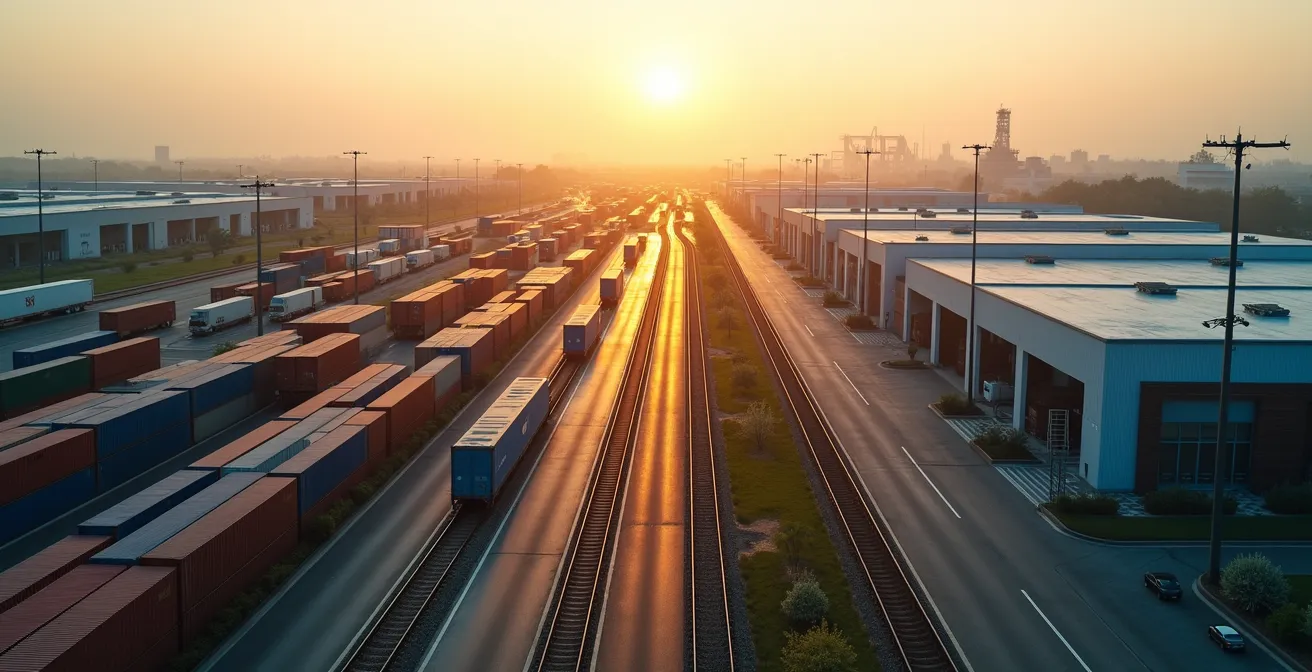
The key to cutting intermodal emissions isn’t just mode-shifting to rail; it’s architecting a system that eradicates the operational friction at transfer points where costs and carbon truly accumulate.
- Genuine carbon savings come from synchronizing truck, rail, and sea handoffs to eliminate idling and dwell time.
- A unified data strategy, integrating EDI streams from all carriers, is the non-negotiable backbone of an efficient, low-carbon intermodal network.
Recommendation: Shift your focus from managing individual modes to designing a seamless, end-to-end logistics ecosystem that treats transfer points as its most critical components.
For sustainability directors and logistics managers, the pressure to reduce the supply chain’s carbon footprint is immense. A 20% reduction target is no longer an ambition but a mandate. The most common answer is a swift pivot to intermodal transport, leveraging the inherent fuel efficiency of rail and sea over long-haul trucking. This advice, while correct, only scratches the surface. Simply shifting freight from road to rail is a tactical move, not a systemic solution. It often ignores the immense inefficiencies that arise at the very seams of the network.
The real challenge—and the greatest opportunity for optimization—lies in the transfer points. Ports, rail ramps, and inland terminals are frequent chokepoints where delays, dwell charges, and, consequently, unnecessary emissions accumulate. A container sitting idle for days due to a chassis mismatch or a truck waiting in a queue because of unsynchronized schedules negates many of the environmental gains sought. The journey becomes a series of disjointed legs rather than a single, fluid movement.
But what if the solution wasn’t just to use greener modes, but to architect a truly integrated system? This is where an eco-conscious, integrative approach transforms the entire equation. The focus shifts from managing modes to designing flow. By treating the intermodal network as a single, cohesive ecosystem and meticulously engineering the handoffs between road, rail, and sea, we can unlock profound reductions in both carbon emissions and operational costs.
This guide provides an architect’s blueprint for achieving that seamless integration. We will deconstruct the common bottlenecks, from terminal congestion to contract liabilities, and provide actionable frameworks for building a resilient, efficient, and genuinely sustainable intermodal strategy. It’s time to move beyond simple mode-shifting and start engineering the future of green logistics.
Summary: An Architect’s Blueprint for Eco-Efficient Intermodal Transport
- Why transfer points are the biggest bottleneck in your intermodal strategy?
- How to synchronize truck arrival with rail availability to eliminate waiting time?
- Multimodal BL vs Separate contracts: Which protects the shipper better in case of damage?
- The chassis mismatch error that leaves containers stranded at the rail ramp
- When to integrate EDI streams from rail and ocean carriers into one dashboard?
- How to navigate freight terminals congestion to avoid detention charges?
- How to calculate the logistics carbon footprint of a multi-leg international shipment accurately?
- How to inspect standardized ISO containers to prevent water damage to high-value goods?
Why transfer points are the biggest bottleneck in your intermodal strategy?
The promise of intermodal logistics lies in combining the strengths of different transport modes. However, the true performance of the entire system is dictated by its weakest links: the transfer points. These hubs—ports, rail ramps, and inland depots—are where the smooth flow of cargo breaks down into a series of potential failures. Instead of a seamless handoff, shippers often face a gauntlet of delays, creating a cascade of operational and environmental costs. The core issue is dwell time, the period a container sits idle waiting for the next leg of its journey.
This idle time is not just a logistical nuisance; it’s a significant source of inefficiency and waste. According to a report from ITS Logistics, persistent container dwell issues at major West Coast ports like Los Angeles/Long Beach are causing severe operational concerns across North America. This is often due to a flatcar imbalance for inland-bound freight, meaning containers arrive by sea but have no rail capacity waiting for them. Each day a container sits, it occupies valuable space, risks incurring demurrage fees, and represents a failure in network synchronization.
These bottlenecks are exacerbated by a lack of visibility and coordination between stakeholders. A carrier, a terminal operator, and a drayage company may all work from different information systems, leading to misaligned schedules and resource allocation. The result is trucks arriving at congested gates, containers being buried in a stack, and equipment like chassis being unavailable when needed. Architecting a greener supply chain, therefore, begins with a relentless focus on de-congesting these critical nodes and transforming them from points of friction into zones of frictionless transfer.
How to synchronize truck arrival with rail availability to eliminate waiting time?
Eliminating waiting time at terminals is the single most effective lever for reducing both costs and emissions in an intermodal system. The solution lies in moving from a reactive “first-come, first-served” model to a predictive and synchronized system architecture. This requires the seamless integration of data streams to create a dynamic appointment system that adjusts in real time. The goal is to ensure that the truck, the container, and the rail slot are all ready and available at the exact same moment.
The growth of intermodal transport makes this optimization critical. According to the Association of American Railroads, May 2024 saw an average of 256,250 average intermodal units per week, a significant increase year-over-year. To manage this volume efficiently, logistics architects must implement technologies like GPS geofencing. A geofence can automatically trigger an alert to the terminal when a truck is, for example, 30 miles away, allowing terminal operators to prepare the specific container for loading. This predictive scheduling minimizes driver wait time and reduces fuel consumption from idling engines.
Visualizing this system helps clarify its power. A modern GPS tracking device can overlay geofenced zones around a rail terminal, creating a digital perimeter that automates communication and scheduling.
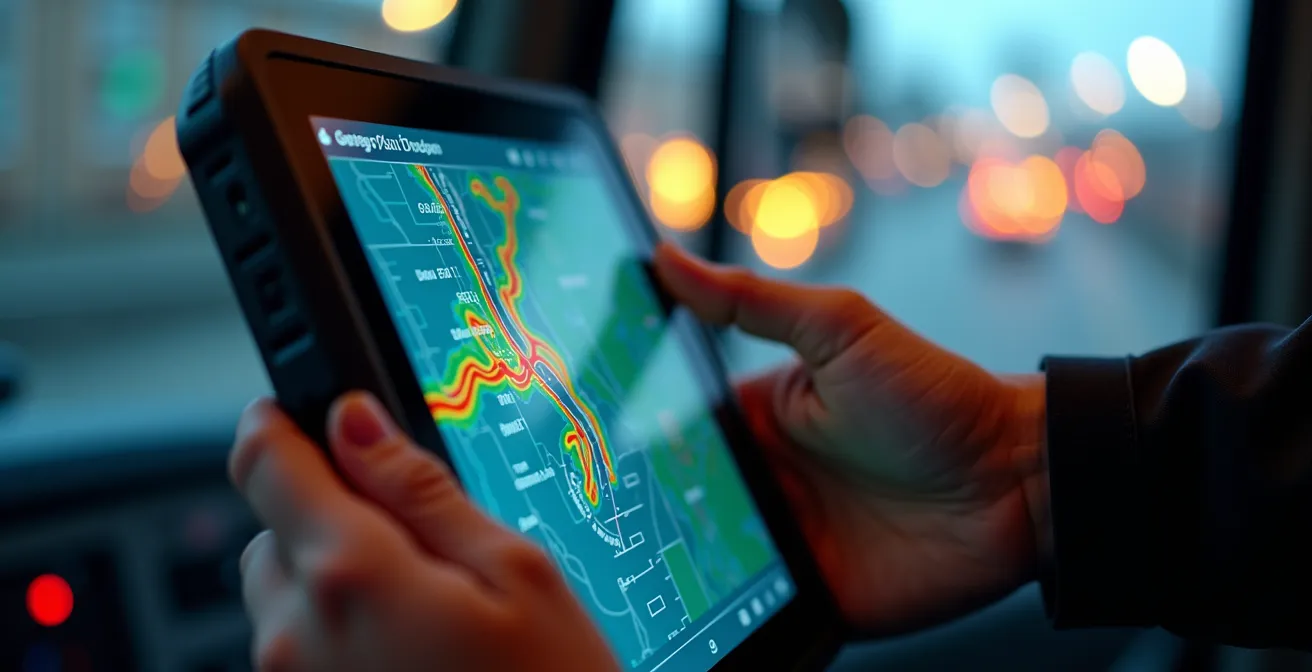
This level of real-time visibility, connecting terminal information portals with in-cab telematics, is the foundation of a smart, responsive intermodal network. It transforms the terminal from a chaotic yard into a finely tuned mechanism for freight flow, directly contributing to a lower carbon footprint through radical efficiency.
Action Plan: Implementing Real-Time Terminal Synchronization
- Evaluate transfer point reliability and congestion patterns using historical data to identify peak and off-peak windows.
- Implement predictive scheduling based on GPS geofencing triggers that alert terminals of inbound truck ETAs.
- Connect with terminal information portal APIs to automate the booking and verification of available time slots.
- Deploy real-time tracking systems for container-specific visibility, ensuring the right box is ready at the right time.
- Establish dynamic appointment systems that can automatically adjust schedules based on actual conditions like traffic or terminal congestion.
Multimodal BL vs Separate contracts: Which protects the shipper better in case of damage?
As you architect a seamless intermodal flow, the legal and financial framework underpinning the journey is as critical as the physical logistics. When cargo is damaged, the type of contract you hold determines the complexity, speed, and success of your claim. As Maersk Logistics highlights in their Intermodal Transport Guide, the choice often comes down to two models. As they state:
Multimodal transport is managed under a single contract with one logistics provider who oversees the full journey
– Maersk Logistics, Intermodal Transport Guide 2025
This single point of accountability is the core advantage of a Multimodal Bill of Lading (B/L). With a multimodal B/L, one carrier assumes end-to-end responsibility for the cargo, regardless of which leg of the journey the damage occurred on. This drastically simplifies the claims process for the shipper, who deals with a single entity. Conversely, using separate contracts for each mode (ocean, rail, truck) creates a fragmented liability chain. If damage is discovered at the final destination, the shipper may face the daunting task of proving exactly *where* the incident happened, leading to disputes between carriers who are each incentivized to deny responsibility.
While separate contracts can sometimes offer more negotiation power on individual leg pricing, the complexity they introduce often outweighs the benefits, especially for high-value goods. The following table breaks down the key differences to help guide your strategic decision.
| Aspect | Multimodal Bill of Lading | Separate Contracts |
|---|---|---|
| Contract Management | Single contract, one provider | Multiple contracts per mode |
| Liability Coverage | End-to-end responsibility | Mode-specific liability |
| Claims Process | Single point of contact | Multiple claims possible |
| Documentation | Simplified, unified | Complex, mode-specific |
| Cost Control | Less flexibility | More negotiation power |
For a sustainability director or logistics manager focused on creating a resilient and efficient system, the multimodal B/L offers superior protection and operational simplicity. It aligns with the principle of a single, integrated logistics architecture, ensuring that accountability is as seamless as the desired cargo flow.
The chassis mismatch error that leaves containers stranded at the rail ramp
Among the many potential points of failure at an intermodal terminal, the chassis mismatch is one of the most frustrating and costly. A chassis is the wheeled frame a container is mounted on for road transport. A mismatch occurs when the right type or number of chassis are not available when a container needs to be moved from a train to a truck, or vice versa. This seemingly simple error can bring a supply chain to a screeching halt.
The consequences are immediate and severe. Industry data shows that containers can sit for 3-5 days longer than usual at inland ramps purely due to chassis shortages. This not only causes significant delays for the shipper but also creates a domino effect of congestion within the terminal. A stranded container occupies a valuable slot, preventing other containers from being processed efficiently. The BNSF Railway’s proposal to levy demurrage fees in locations like Dallas and Phoenix due to a worsening shortage of 53-foot chassis highlights how this issue directly translates into financial penalties.
This problem is often rooted in fragmented chassis pools, where different shipping lines or leasing companies manage their own equipment, leading to poor utilization and regional imbalances. A key part of architecting a solution is promoting interoperable or “gray” chassis pools, where any carrier can use any available chassis. Furthermore, technology can play a vital role. Automated gate systems using Optical Character Recognition (OCR) can validate container and chassis information instantly, flagging mismatches before they cause a blockage.

By focusing on both the commercial model (interoperable pools) and technology (automated validation), logistics architects can design a system that mitigates this critical bottleneck, ensuring containers keep moving and carbon-intensive idling is minimized.
When to integrate EDI streams from rail and ocean carriers into one dashboard?
In a seamlessly integrated intermodal system, data is the connective tissue. Electronic Data Interchange (EDI) messages are the standard for communication between carriers, terminals, and shippers, transmitting everything from booking confirmations to gate movements. However, receiving separate EDI streams from ocean carriers, rail operators, and drayage partners creates a fragmented and often confusing picture. The strategic question is not *if* you should integrate these streams, but *when* the cost of not doing so becomes too high.
The tipping point for integration typically arrives when the scale and complexity of your operations lead to recurring service failures caused by a lack of unified visibility. If you are managing over 50 intermodal shipments per month and find that manual data entry errors or real-time visibility gaps are causing weekly service disruptions, it is time to invest in a unified dashboard. A centralized platform aggregates all EDI streams (like a 301 for booking, a 315 for shipment status, or a 404 for bill of lading) into a single source of truth. This allows your team to stop chasing information across multiple carrier portals and start making proactive decisions.
The decision to integrate should be driven by a cost-benefit analysis. Start by calculating the “cost of inefficiency.” This includes tangible expenses like demurrage and detention fees caused by delays, as well as the labor costs associated with manually tracking shipments and resolving data discrepancies. If your monthly manual data entry error rate exceeds 2% of shipment volume, or if the accumulated inefficiency costs over six months surpass the projected cost of an integration project, the business case is clear. A unified dashboard is no longer a luxury but an essential tool for building a scalable, low-carbon, and resilient logistics operation.
How to navigate freight terminals congestion to avoid detention charges?
Terminal congestion is a chronic plague on global supply chains, and its impact is felt most acutely in the form of detention and demurrage charges. These fees, levied for the late pickup of containers or late return of equipment, are a direct financial penalty for inefficiency. As recent industry analysis reveals, systemic delays are worsening; for example, Europe-to-Asia shipments averaged 84 days in Q2 2024, an 11-day increase year-over-year. Navigating this environment requires a proactive and data-driven strategy.
The first step is gaining end-to-end visibility. You cannot manage what you cannot see. A unified tracking platform that aggregates data from ocean carriers, rail lines, and drayage providers is essential. This allows you to anticipate delays before they happen and adjust your plans accordingly. For instance, if you see a vessel is projected to arrive late, you can proactively reschedule the drayage appointment to avoid sending a truck to a closed or congested terminal.
Secondly, diversification of routing and gateways is a powerful hedging strategy. Over-reliance on a single port or rail ramp makes you vulnerable to localized disruptions. As seen with ongoing issues on the U.S. West Coast, where rail infrastructure cannot keep up with container volumes, shippers are being forced to develop alternative drayage strategies. This might involve routing cargo through a less congested port, even if it’s further away, or using an inland port to clear customs and break down shipments before the final-mile delivery. By building flexibility into your network design, you can bypass chokepoints and maintain flow.
Finally, fostering strong partnerships with your carriers and drayage providers is key. Work with partners who offer flexible “free time” agreements and who are willing to collaborate on creative solutions, such as establishing “peel piles” or dedicated drop-and-hook programs. These strategies can significantly reduce turn times at terminals, helping you avoid detention charges and keep your carbon footprint in check by minimizing truck idling.
How to calculate the logistics carbon footprint of a multi-leg international shipment accurately?
For a sustainability director, making a credible claim about carbon reduction requires robust and defensible data. “Greenwashing” is a significant risk, and simply stating you’ve shifted to intermodal is not enough. You must be able to accurately calculate the carbon footprint of a multi-leg shipment from origin to destination. This granular approach not only validates your sustainability efforts but also reveals further optimization opportunities. The incentive is clear: studies have demonstrated that greenhouse gas emissions plummet by over 65% for freight trains on shipments over 1,000 miles compared to trucks.
Accurate calculation follows a “Well-to-Wheel” (WTW) methodology, which accounts for the total emissions associated with fuel, from its extraction and production (Well-to-Tank) to its combustion in the vehicle’s engine (Tank-to-Wheel). This comprehensive view is critical for comparing different modes and routes fairly. The process involves:
- Calculating each transport leg (e.g., drayage truck, ocean vessel, rail, final-mile truck) separately using mode-specific emission factors.
- Including emissions from fuel production and distribution (Well-to-Tank).
- Adding emissions from actual fuel combustion during transit (Tank-to-Wheel).
- Factoring in non-productive emissions from activities like idling at terminals or repositioning empty containers.
- Applying standardized conversion factors (such as those in ISO 14083:2023) to ensure consistency.
- Summing the emissions of all legs to get the total multi-modal carbon footprint.
To ensure credibility and comparability, these calculations should adhere to established industry standards. Several frameworks exist, each with a slightly different scope and focus. Choosing the right one depends on your reporting needs and geographical scope.
| Standard | Scope | Key Features |
|---|---|---|
| GLEC Framework | Global multimodal | Comprehensive mode coverage, industry standard |
| ISO 14083:2023 | International transport | Latest methodology, regional emission factors |
| GHG Protocol | Corporate reporting | Scope 3 emissions, widely accepted |
| EN 16258 | European transport | EU compliance, detailed factors |
By adopting a recognized standard and a rigorous WTW methodology, you can move from estimation to empirical measurement, providing stakeholders with transparent and trustworthy data on your journey toward a 20% carbon reduction.
Key Takeaways
- The greatest carbon and cost savings in intermodal logistics are found by eliminating friction at transfer points, not just by shifting modes.
- Real-time data synchronization between trucks, terminals, and rail is the core operational lever for cutting emissions and avoiding costly delays.
- Accurate, well-to-wheel carbon accounting, based on standards like ISO 14083, is non-negotiable for proving impact and avoiding greenwashing.
How to inspect standardized ISO containers to prevent water damage to high-value goods?
While optimizing for flow and carbon reduction, a logistics architect must never lose sight of the primary mission: delivering goods safely and intact. For high-value or moisture-sensitive products, the integrity of the standardized ISO container is paramount. A small leak in a door seal or a tiny crack in a roof panel can lead to catastrophic water damage over a multi-week journey, rendering any carbon savings irrelevant. A rigorous inspection protocol is therefore an essential component of a resilient intermodal system, directly protecting its financial viability.
A thorough inspection goes far beyond a quick visual check. It is a systematic process designed to identify vulnerabilities before the container is loaded. This is especially important for goods that are susceptible to “container rain,” a phenomenon where temperature fluctuations cause condensation to form on the ceiling and drip onto the cargo. To prevent this and other forms of water damage, an advanced protocol should include:
- Pre-loading acclimatization: Before loading goods from a climate-controlled warehouse, allow the container to acclimatize to the ambient temperature for 2-4 hours to reduce the risk of immediate condensation.
- Ultrasonic leak detection: Go beyond the simple “light test” (standing inside and looking for light) by using ultrasonic devices to check the integrity of all door seals and corner castings, which can detect leaks invisible to the naked eye.
- Real-time humidity monitoring: Install IoT-enabled humidity sensors inside the container. These can be configured to send real-time alerts if the relative humidity (RH) exceeds a set threshold, such as 70%, allowing for intervention at the next transshipment point.
- Documented evidence: Use timestamped photos to document the condition of the container and the inspection results. This creates an indisputable record that is invaluable for insurance claims in the event of damage.
Integrating these advanced inspection steps into your standard operating procedures provides a critical layer of defense. It ensures that the efficiency gains and cost benefits of intermodal transport, which The Journal of Commerce documents as providing 15% to 18% lower freight transportation costs compared to truckload, are not wiped out by a single preventable incident of cargo damage.
To truly achieve your sustainability goals, it’s time to move beyond managing individual shipments and start architecting your end-to-end intermodal ecosystem. This systemic approach, focused on eliminating friction and enhancing visibility, is the only path to significant, verifiable carbon reduction. Begin by auditing your key transfer points today to identify the first and most impactful opportunities for optimization.