

The greatest risk in a global supply chain isn’t a single regulation breach; it’s the systemic failure that made the breach inevitable.
- Effective safety isn’t enforced from the top down; it’s engineered into daily operations and owned by local teams.
- Moving from reactive punishment to proactive, predictive risk management is the only way to build a resilient safety culture.
Recommendation: Stop policing compliance and start designing systems where safety is the default outcome. Establish a single, uncompromising “Golden Standard” that exceeds all local requirements.
As a Global HSE Director, you understand the weight of responsibility that spans continents. The question isn’t whether an incident will happen, but where and when. A call in the middle of the night about an accident at a warehouse thousands of miles away is our shared nightmare. The typical response is a flurry of activity: review the global policy, issue a new directive, and enforce stricter adherence to local laws. We’re told to build a bigger rulebook and police it harder.
But this approach is a trap. It treats symptoms, not the disease. It assumes that people fail, when in reality, systems fail people. In a fragmented supply chain with diverse cultures, languages, and regulations, a rigid, top-down enforcement model is destined to crack under pressure. It creates a culture of compliance-for-show, where a box is ticked but the underlying risk remains, waiting for the right moment to surface.
What if the answer wasn’t more rules, but better-designed systems? This is our mandate. We must shift our focus from policing safety to engineering it. This means creating an environment where the safe choice is the easiest choice, where reporting a near-miss is a celebrated contribution, not a confession, and where our standards are so high they make local compliance a secondary concern. It’s about building a framework so robust it anticipates and absorbs failure before it leads to catastrophe.
This guide lays out the strategic framework for achieving precisely that. We will dissect the true cost of failure, explore how to build a unified culture without ignoring local realities, and detail the systems needed to move from a reactive to a predictive safety posture. This is how we build a truly resilient and uncompromising global safety program.
Summary: A Director’s Mandate for Global Supply Chain Safety
- Why a single forklift accident costs 10x more than the medical bills?
- How to ensure PPE compliance in regions with lax safety cultures?
- International ISO standards vs Local laws: Which takes precedence?
- The scheduling error that pushes drivers beyond legal driving hours
- How to encourage employees to report near-misses without fear of punishment?
- How to prepare for upcoming environmental mandates impacting diesel fleets?
- How to speed up order picking accuracy without increasing human error rates?
- How to implement a predictive vehicle maintenance program to reduce breakdowns?
Why a single forklift accident costs 10x more than the medical bills?
The direct cost of an accident—the medical bills, the damaged equipment—is a fraction of the real financial impact. As directors, we must articulate the full, systemic cost of a safety failure. This is not about one employee’s injury; it’s a catastrophic event that sends shockwaves through the entire value chain. The real damage is measured in lost contracts, plummeting investor confidence, and a tarnished reputation that can take years to rebuild. A single incident can trigger a chain reaction, leading to contract reviews and potential loss of major clients who can no longer trust our operational integrity.
The financial bleeding extends far beyond the initial incident. We face increased management overhead to handle crisis control, soaring insurance premiums, and the immense cost of litigation. Furthermore, these events have a profound impact on our brand. In an era of heightened ESG scrutiny, a significant safety incident directly harms our ESG score, making us less attractive to investors. In fact, research from Northwestern University reveals that ESG-related incidents in the supply chain can lead to significant, long-term stock price declines. It erodes trust not just with customers, but also with our own workforce, making talent acquisition and retention significantly more challenging.
The true cost is the loss of operational stability and market trust. When we frame safety investment not as a cost center but as a non-negotiable insurance policy against systemic collapse, the conversation changes. The cost of prevention is insignificant compared to the cost of failure. This understanding is the foundation of an uncompromising safety culture.
How to ensure PPE compliance in regions with lax safety cultures?
Mandating PPE use in regions with a lax safety culture often results in superficial compliance at best, and outright defiance at worst. The traditional approach of top-down enforcement and punishment fails because it ignores the root cause: the local environment and behavioral norms. Our mandate is not to force compliance, but to engineer it through behavioral nudging. This means making the safe behavior the easiest and most socially rewarding path, rather than a rule to be resentfully followed. It’s a shift from policing to influencing.
This approach involves co-designing solutions with local teams. Instead of a one-size-fits-all helmet, we must consider climate-adapted equipment that is comfortable to wear in hot and humid conditions. Instead of simply punishing non-compliance, we should leverage social proof and positive reinforcement, celebrating teams and individuals who demonstrate a commitment to safety. As a real-world example, Huawei has successfully enhanced supplier safety by moving beyond simple audits to provide tangible support, deploying intelligent AI systems for detecting infractions and assisting suppliers in achieving work safety certifications. This transforms the relationship from adversarial to collaborative.
The following table illustrates the fundamental shift in mindset required to build a culture of ownership rather than one of mere compliance.
| Traditional Enforcement | Behavioral Nudging |
|---|---|
| Rules and punishment focus | Social proof and positive reinforcement |
| Top-down mandate | Co-design with local teams |
| One-size-fits-all PPE | Climate-adapted equipment selection |
| Compliance monitoring | Ownership and empowerment focus |
By focusing on empowerment and making safety practical for the local context, we foster genuine buy-in. This is how we turn a “lax” culture into a proactive one, where safety becomes a source of pride, not a burden.
International ISO standards vs Local laws: Which takes precedence?
The debate over whether to follow international standards like ISO 45001 or local laws presents a false choice. A truly resilient global safety framework does not choose between them; it transcends them. The correct answer is that our own internal standard—our “Golden Standard”—must take precedence by being stricter than any single local law or international guideline. This approach eliminates ambiguity and creates a single, uncompromising benchmark for every facility and every employee, regardless of location. It simplifies compliance by establishing one high bar for everyone to clear.
This Golden Standard becomes the universal language of safety in our supplier contracts and operational procedures. It positions safety not as a legal hurdle but as a commercial prerequisite; indeed, according to supply chain security frameworks, adoption of standards like ISO 28000 is increasingly a condition for doing business. By setting our own bar higher, we are always compliant, and we insulate our operations from the risks of lax local enforcement or shifting regulations. This requires a dynamic compliance matrix that maps all requirements, ensuring our Golden Standard consistently represents the highest common denominator.

Developing and implementing such a standard is a strategic undertaking. It moves us from a reactive posture of checking local compliance boxes to a proactive stance of defining what safety means for our entire organization. It is the ultimate expression of an uncompromising commitment to protecting our people and our business.
Action plan: Building your Golden Standard framework
- Map your supply chains to gain a deep understanding of existing Occupational Safety and Health (OSH) challenges in each region.
- Embed OSH and employment injury protection clauses directly into your procurement practices and supplier contracts.
- Establish internal standards that are demonstrably stricter than any single local requirement you operate under.
- Create and maintain a dynamic compliance matrix that maps all local, national, and international requirements against your Golden Standard.
- Use established ISO standards as a universal language and foundation when drafting and negotiating supplier contracts.
The scheduling error that pushes drivers beyond legal driving hours
When a driver is involved in a fatigue-related incident, the first instinct is to blame the individual. This is a critical error. More often than not, the driver is the final victim of a systemic scheduling failure. Unrealistic deadlines, inefficient routing, and a lack of buffer time for unforeseen delays create a pressure cooker environment where drivers are forced to choose between meeting a deadline and adhering to legal driving hours. This is not a human error; it is a system designed for failure. Our mandate is to re-engineer this system to protect our drivers from such impossible choices.
The solution lies in moving from static schedules to dynamic, predictive fatigue management. By integrating data streams—including route information, traffic patterns, engine data, and even driver biometrics where appropriate—we can build models that predict and flag fatigue risks before a driver even starts their engine. These systems can model optimal rest windows and identify conflicts that lead to cumulative fatigue. The platform Readi, for example, provides scientifically validated fatigue predictions that are operationally practical for dispatchers.
This data-driven approach yields quantifiable results. It’s not a theoretical exercise. In practice, transport companies using predictive analytics reported a 22% reduction in fatigue-related accidents. This proves that by fixing the system, we protect the person. We must stop managing schedules and start managing risk. This involves investing in the technology and processes that make fatigue predictable and preventable, ensuring our drivers are always set up for a safe journey.
How to encourage employees to report near-misses without fear of punishment?
A silent workforce is the most dangerous risk in any operation. If employees are afraid to report near-misses, we are flying blind, completely unaware of the systemic failures that will inevitably lead to a major incident. The only way to get this vital data is to cultivate an environment of absolute psychological safety. This is a non-negotiable state where every employee, from the loading dock to the executive suite, believes they can report a problem or a mistake without any fear of punishment, humiliation, or retribution. They must see themselves as critical data sources, not potential culprits.
This requires a radical shift from a blame culture to a blameless investigation framework. When a near-miss is reported, the focus must immediately turn to “What in the system allowed this to happen?” not “Who made the mistake?”. To build this trust, we must implement clear, transparent policies. This includes public tracking of all near-miss reports, from initial submission to the final resolution and corrective actions taken. When employees see their reports lead to tangible improvements, they understand their voice matters and the process works.
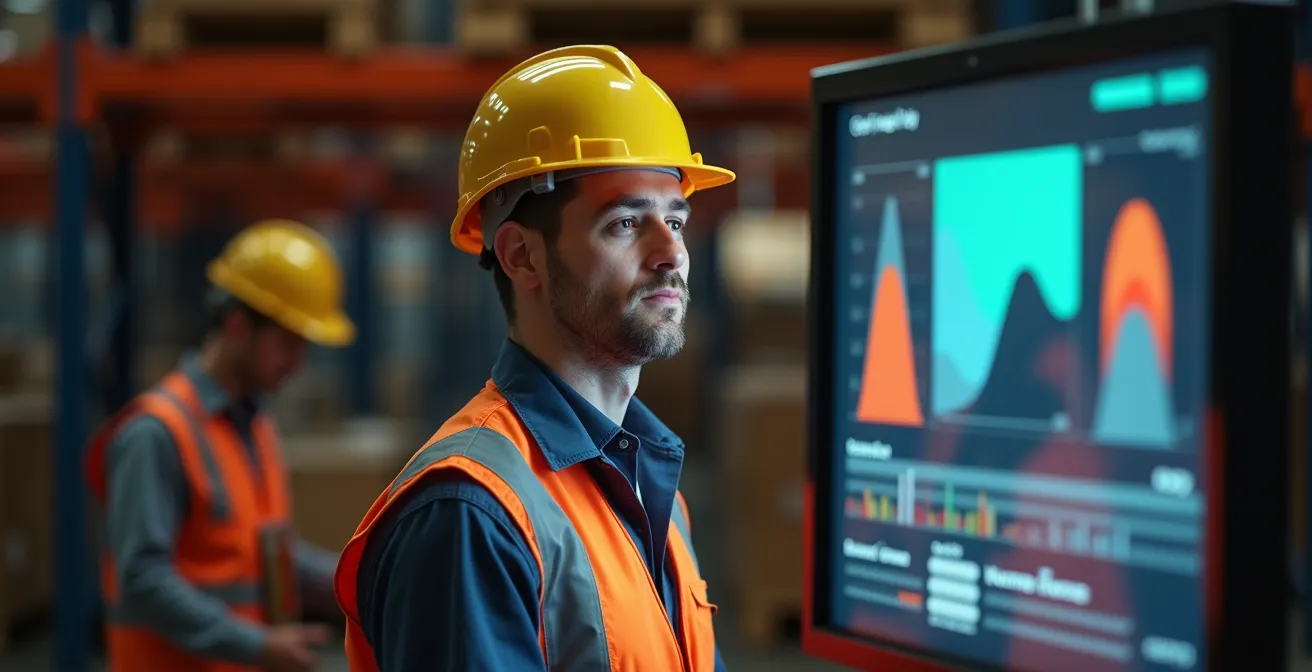
This systemic view is backed by extensive research. As authors in a Scientific Reports study on supply chain safety note, building a culture of proactive reporting is essential.
the establishment of a comprehensive supply chain safety management system framework is of paramount importance and is the key to ensuring that SMMs fulfill their safety production contracts. This includes the development of detailed work safety compliance standards for suppliers, a thorough supplier safety inspection regime, and an effective reward and penalty system.
– Scientific Reports Study Authors, Enhancing work safety behavior through supply chain safety management
Ultimately, psychological safety isn’t a “soft” skill; it is a hard requirement for risk management. A workforce that actively reports near-misses is the most powerful leading indicator of safety performance we can possibly have.
How to prepare for upcoming environmental mandates impacting diesel fleets?
The transition away from diesel is not a distant, abstract threat; it is an immediate operational and financial reality. Upcoming environmental mandates are a predictable risk that must be managed with the same rigor as any safety hazard. Waiting for regulations to be finalized is a recipe for disruption and costly, rushed compliance. Our mandate as HSE directors is to lead a proactive decarbonization strategy, treating it as a core component of our risk management framework. With the context that total emissions from container shipping rose by a staggering 13.8% in 2024 alone, the pressure for legislative action is immense and inevitable.
A proactive approach involves building a transition portfolio strategy. This is not about replacing the entire fleet overnight. It’s about making calculated, incremental investments in a mix of cleaner transportation methods. This portfolio could include piloting electric vehicles for last-mile delivery, exploring hydrogen-powered trucks for long-haul routes where feasible, and aggressively optimizing shipping routes to reduce fuel consumption. The goal is to build operational experience with these new technologies on a smaller scale, so we are prepared to scale up rapidly when mandates take full effect.
This strategy also extends to collaborative efforts. The rise of “green corridors” for shipping is a prime example of how industry players can work together to decarbonize specific, high-volume freight routes. By participating in these initiatives, we not only reduce our environmental footprint but also position our company as a leader in sustainable logistics. We must frame this transition not as a compliance burden, but as a competitive advantage and a critical step in future-proofing our supply chain.
How to speed up order picking accuracy without increasing human error rates?
The demand for faster order fulfillment often creates a dangerous tension with accuracy. Pushing workers to move faster without changing the system is the fastest way to increase human error, leading to costly mis-picks, returns, and dissatisfied customers. The solution isn’t to demand more from our people, but to design a smarter, more ergonomic workspace. We must engineer a system where accuracy is the path of least resistance. This is a classic systemic design challenge that requires a multi-faceted approach, focusing on reducing physical and cognitive load.
First, we must optimize the physical environment. This starts with slotting optimization, placing the highest-volume items in the “golden zone” (between the waist and shoulders) to minimize bending and reaching. It also includes improving lighting to reduce eye strain and installing anti-fatigue mats to lessen physical stress over a long shift. These are not perks; they are critical investments in sustainable performance.

Second, we must reduce the cognitive load. Tools like voice-directed picking free up a worker’s hands and eyes, allowing them to focus solely on the task of picking the correct item. We can also redesign incentive structures. Instead of rewarding pure speed, which encourages rushing, we should implement gamification that focuses on mastery and consistency. For example, creating accuracy streak bonuses celebrates and rewards the desired behavior without inadvertently punishing careful work. By optimizing both the physical and cognitive aspects of the job, we can achieve the dual goals of speed and accuracy without compromising the well-being of our workforce.
Key takeaways
- Systemic Costs Are Real: A safety failure’s true cost goes far beyond medical bills, impacting stock price, client trust, and your ESG score.
- Engineer, Don’t Enforce: A resilient safety culture is built on behavioral nudging and psychological safety, not top-down punishment.
- Adopt a Golden Standard: Create a single, internal safety standard stricter than any local law to simplify compliance and eliminate ambiguity.
- Embrace Predictive Resilience: Use data to anticipate and mitigate risks like driver fatigue and vehicle breakdowns before they become incidents.
How to implement a predictive vehicle maintenance program to reduce breakdowns?
A vehicle breakdown is never just a mechanical failure; it’s a critical disruption to the supply chain and a potential safety incident. Traditional maintenance schedules, based on mileage or time, are a relic. They are reactive and fail to account for the actual wear and tear a vehicle endures. With reports showing that 76% of European shippers experienced supply chain disruptions in 2024, we cannot afford to rely on outdated, reactive methods. Our mandate is to implement a predictive vehicle maintenance program that anticipates failures before they happen.
This requires a fundamental shift to a data-centric approach. Modern vehicles are rich sources of data. By harnessing the proliferation of client and third-party data streams, we can build a comprehensive picture of a vehicle’s health. This includes telemetry from the engine, maintenance data, braking profiles, data from avoidance maneuvers, and even route information. A truck operating in a mountainous region, for example, will experience different stresses than one operating on flat highways, and its maintenance schedule must reflect that reality.
Implementing a predictive program means using analytics to identify subtle patterns that precede a failure. An algorithm might flag a minor change in engine temperature or a shift in braking behavior as a leading indicator of a future component failure. This allows maintenance to be scheduled proactively, during planned downtime, rather than reactively on the side of a highway. This not only dramatically reduces unplanned breakdowns and their associated costs but also enhances the safety of our drivers and the public. It is the ultimate form of predictive resilience, transforming maintenance from a necessary evil into a strategic advantage.
The time for reactive safety is over. The only path forward is to engineer a systemic, data-driven, and culturally-embedded safety framework. Begin by assessing your current systems against this proactive mandate and identify the first, most critical area for redesign.