
Accurately calculating your logistics carbon footprint is no longer about environmental compliance; it’s about identifying and mitigating direct financial and regulatory liabilities hidden in your supply chain.
- The vast majority of emissions—and therefore risk—are in Scope 3, originating from carriers whose data is often opaque.
- Vague “eco-friendly” claims are now being prosecuted as fraud, making auditable data, compliant with standards like ISO 14083, non-negotiable.
Recommendation: Shift from simple offsetting to strategic decarbonization by focusing on operational efficiencies and adopting a risk-based approach to supply chain management.
For sustainability officers and logistics managers, the pressure to deliver accurate ESG reporting is intensifying. The task of calculating the carbon footprint of a multi-leg international shipment often feels like an exercise in chasing incomplete data and navigating a maze of methodologies. The common advice—to follow the GLEC Framework and request data from carriers—is a starting point, but it barely scratches the surface of the underlying challenge. This approach treats carbon accounting as a retrospective reporting task, a cost center to be managed.
But what if this perspective is fundamentally flawed? The true challenge isn’t just measuring emissions; it’s understanding them as a proxy for operational inefficiency and, more critically, as a source of future financial and regulatory liability. The conversation is shifting from “What is our footprint?” to “How defensible is our calculation under regulatory scrutiny?” Vague claims of sustainability are no longer a marketing asset; they are a legal liability. This requires a paradigm shift: viewing carbon accounting not as an environmental checkbox, but as a core component of strategic risk management.
This article provides a framework for building a robust and defensible carbon accounting strategy. We will dissect the primary sources of your emissions, evaluate the real-world choices between offsetting and direct investment, and provide actionable methods to prepare for the coming wave of environmental mandates. The goal is to transform your ESG reporting from a reactive burden into a proactive tool for building a more resilient, efficient, and compliant global supply chain.
To navigate this complex but crucial topic, this guide is structured to address the key strategic questions you face. The following sections will provide a clear path from identifying hidden emissions to implementing defensible optimization strategies.
Summary: A Strategic Guide to Logistics Carbon Footprint Calculation
- Why 90% of your company’s carbon footprint hides in your carriers’ exhaust?
- How to choose between buying carbon credits and investing in greener fuel?
- HVO100 vs Electric trucks: Which is the realistic choice for long-haul today?
- The “Eco-Friendly” claim that regulators are starting to fine as fraud
- How to increase pallet density to reduce CO2 per unit by 15%?
- How to prepare for upcoming environmental mandates impacting diesel fleets?
- How to realign strategic management of global supply chains for resilience over cost?
- How to optimize flow through intermodal logistics to reduce carbon footprint by 20%?
Why 90% of your company’s carbon footprint hides in your carriers’ exhaust?
For most companies, the most significant source of emissions—and therefore the most significant source of unmanaged risk—lies outside their direct control. These are the Scope 3 emissions, generated by assets you don’t own, primarily the vehicles of your logistics carriers. While companies focus on optimizing their own facilities (Scope 1 and 2), the real carbon liability is embedded within the supply chain. Analysis shows that for many businesses, supply chain emissions account for over 90% of their total carbon footprint. Ignoring this is no longer a viable option; it’s a strategic blind spot.
The core problem is a lack of primary data. Many companies rely on industry-average emission factors, which are imprecise and increasingly indefensible. To move from hidden to managed emissions, a systematic approach to data collection is essential. This involves a maturity journey: starting with default factors for basic compliance, moving to carrier-specific data through engagement programs, and ultimately aiming for real-time telematics data for dynamic and verifiable calculations. This isn’t just about better numbers; it’s about gaining the visibility needed to identify inefficiencies and collaborate with partners on reduction initiatives.
The journey from obscurity to transparency is not just theoretical. Leading organizations are already proving its value. As a case in point, the Gunvor Group, one of the world’s largest independent commodities traders, successfully met growing customer and stakeholder demands for carbon disclosure. By implementing a platform for accurate supply chain footprinting, they systematically collected data that was previously hidden, demonstrating that even in complex, global operations, managing carbon liability is achievable through dedicated effort and the right tools.
Without this visibility, any sustainability claim is built on a foundation of assumptions, exposing the company to significant risk as regulatory standards tighten.
How to choose between buying carbon credits and investing in greener fuel?
Faced with pressure to decarbonize, logistics managers confront a fundamental strategic choice: offset emissions externally by purchasing carbon credits or reduce them internally by investing in greener fuels and technologies. The former offers an immediate, albeit superficial, solution to achieve “carbon neutrality” on paper. The latter requires significant capital investment but delivers a direct, permanent, and verifiable reduction in emissions. This decision is not merely financial; it reflects the company’s long-term commitment to genuine sustainability versus reputational management.
Carbon credits function as a recurring operational expense, with prices subject to high market volatility and the quality of the offset often difficult to verify. They represent an indirect action—paying for a reduction elsewhere—which is coming under increasing scrutiny. In contrast, investing in greener fuels like HVO100 or in fleet electrification is a capital expenditure that can lead to long-term operational savings and insulates the company from the volatile carbon market. Crucially, it represents an emission avoidance strategy, which is far more robust from a regulatory and compliance standpoint than offsetting.
The decision is also influenced by external market pressures. With a growing number of consumers factoring sustainability into their purchasing decisions—a NielsenIQ study found that 78% of U.S. consumers say a sustainable lifestyle is important—a tangible investment in green technology can be a powerful differentiator. The choice between offsetting and direct investment becomes a question of strategic intent: are you managing a number for a report, or are you building a resilient and sustainable logistics operation for the future?
This comparative analysis highlights the trade-offs between immediate offsetting and long-term direct investment in decarbonization.
| Criteria | Carbon Credits | Greener Fuel Investment |
|---|---|---|
| Cost Structure | Recurring operational expense | Capital investment with long-term savings |
| Price Volatility | High – market dependent | Medium – fuel price fluctuations |
| Compliance Risk | Medium – quality verification needed | Low – direct emission reduction |
| Implementation Time | Immediate | 6-24 months |
| Reduction Type | Offsetting (indirect) | Avoidance (direct) |
While carbon credits can serve as a transitional tool, a long-term strategy must focus on direct emission avoidance to build genuine operational resilience.
HVO100 vs Electric trucks: Which is the realistic choice for long-haul today?
For logistics managers committed to direct emission reduction, the two most prominent alternatives for long-haul trucking are Hydrotreated Vegetable Oil (HVO100) and battery-electric vehicles (BEVs). Each technology presents a distinct set of operational realities, and the “best” choice is not universal. HVO100 offers a compelling “drop-in” solution, compatible with existing diesel engines and refueling infrastructure, allowing for rapid deployment and immediate, significant CO2 reduction without massive capital outlay on new vehicles.
Electric trucks, on the other hand, represent a more fundamental technological shift. They promise zero tailpipe emissions and lower running costs but come with significant hurdles for long-haul applications. These include high upfront vehicle costs, payload constraints due to heavy batteries, long charging times, and the current scarcity of high-capacity charging infrastructure along major transport corridors. While ideal for regional or last-mile delivery, the range and dwell-time limitations of BEVs make them a challenging proposition for many long-haul routes today. HVO100, despite being a transitional fuel, provides a pragmatic and immediately scalable path to decarbonization for the existing fleet.
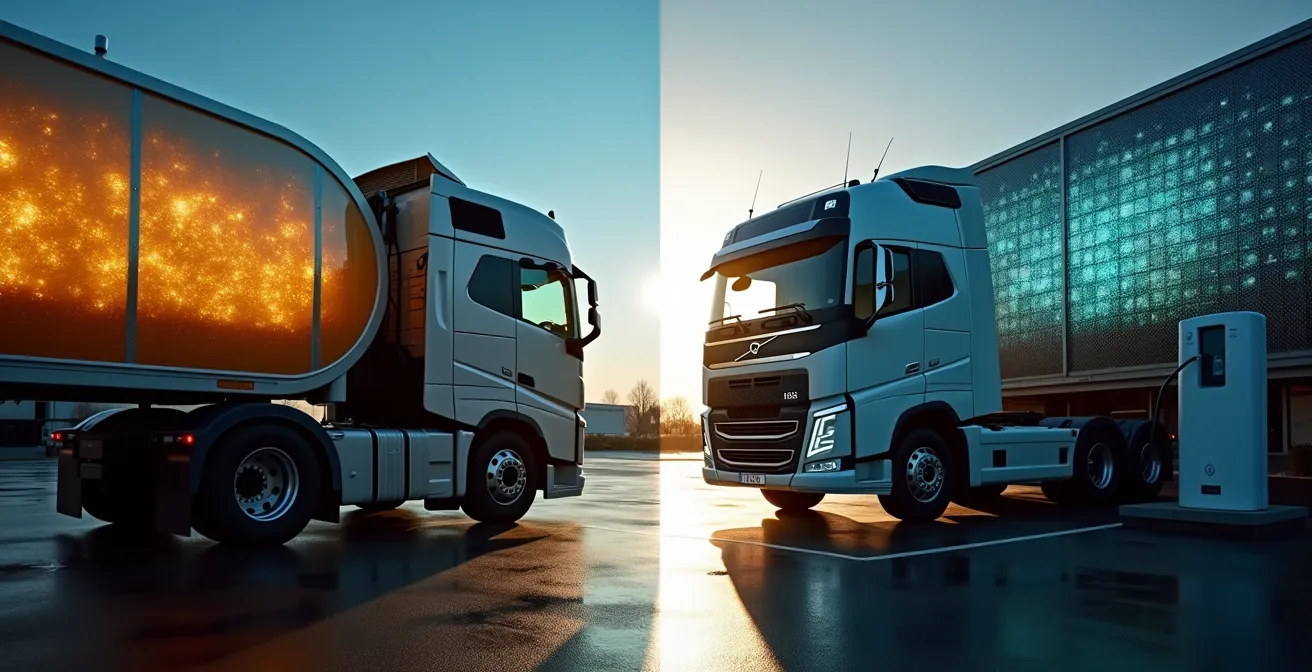
As the image above illustrates, the two technologies rely on fundamentally different infrastructure. The choice is less about which is “greener” in absolute terms and more about which is operationally viable for your specific network right now. A thorough evaluation must go beyond emission factors to include total cost of ownership, route compatibility, and impact on operational efficiency.
Your Action Plan: Operational Viability Scorecard for Fleet Technology
- Evaluate payload constraints: Quantify the impact of battery weight versus the existing fuel tank weight on your typical cargo loads.
- Assess route compatibility: Map your key long-haul routes against current and planned public charging/refueling infrastructure.
- Calculate total cost of ownership (TCO): Model costs including the vehicle, private infrastructure requirements (chargers, tanks), maintenance, and energy/fuel over a 5-10 year period.
- Consider climate impact on performance: Research and factor in the reduced efficiency of batteries in extreme cold or heat prevalent on your routes.
- Compare dwell time requirements: Analyze the operational impact of multi-hour charging stops versus rapid refueling on your delivery schedules and driver hours.
Ultimately, the most realistic path for many long-haul operators may be a hybrid strategy: leveraging HVO100 for immediate impact while selectively piloting electric trucks on suitable routes to prepare for the future.
The “Eco-Friendly” claim that regulators are starting to fine as fraud
The era of making vague, unsubstantiated environmental claims is over. Regulators across the globe are intensifying their crackdown on “greenwashing,” treating misleading “eco-friendly” marketing not as poor practice, but as a form of consumer fraud. For logistics companies and their customers, this means that any public statement about carbon reduction or sustainability must be backed by robust, verifiable, and auditable data. Without it, a company’s environmental, social, and governance (ESG) report can become a source of significant legal and financial risk.
This regulatory shift makes the adoption of standardized calculation methodologies a matter of legal defense. The publication of the ISO 14083 standard in March 2023 was a landmark event. It provides a comprehensive, globally recognized methodology for transport and logistics companies to calculate and report GHG emissions consistently. Adhering to this standard is no longer just good practice for accuracy; it is the primary mechanism to create a defensible and transparent report that can withstand regulatory scrutiny and prevent allegations of greenwashing.
The urgency is compounded by forthcoming legislation. As authorities like Topsector Logistics have noted in their carbon footprinting methodology report, the new landscape demands rigorous reporting:
Companies must produce sustainability reports. As the new Emissions Trading Scheme (ETS-II) is to cap and price almost all CO2 emissions from 2027, reliable and robust reporting on CO2 will become crucial.
– Topsector Logistics, Carbon Footprinting in logistics methodology report
This statement underscores a critical point: carbon data is transitioning from a voluntary metric to a priced commodity within a regulated market. In this context, an inaccurate or indefensible calculation is not just a reporting error; it is a direct financial liability.
Companies must urgently shift their focus from simply producing a carbon number to ensuring the entire data collection and calculation process is transparent, standardized, and legally defensible.
How to increase pallet density to reduce CO2 per unit by 15%?
While alternative fuels and new technologies capture headlines, one of the most effective and immediately available levers for reducing logistics emissions is often overlooked: optimizing load factor. Every truck that leaves a warehouse with empty space represents a significant inefficiency—wasted fuel, wasted capacity, and unnecessary emissions. Increasing pallet density, or the number of units packed onto a single pallet, directly translates into fewer pallets, fewer truck journeys, and a substantial reduction in the carbon footprint per unit sold. This is not a futuristic solution; it is a fundamental principle of efficient logistics.
The transportation sector’s immense environmental impact, responsible for a significant portion of global emissions, underscores the urgency of such optimizations. A study highlighted by Trax Technologies notes that 37% of global energy-related CO2 emissions come from transportation, making every optimization, no matter how small it seems, a critical part of the solution. A 15% reduction in CO2 per unit, achieved simply by re-evaluating packaging and pallet configurations, can have a massive aggregate effect across thousands of shipments. This approach treats emissions not as an unavoidable byproduct, but as a direct indicator of operational waste.
Calculating these savings requires a systematic approach. It involves measuring the baseline, modeling new scenarios, and quantifying the reduction in vehicle-kilometers. By integrating data from Warehouse Management Systems (WMS) and Transportation Management Systems (TMS), companies can pinpoint the products with the lowest density and prioritize them for re-engineering. This turns the abstract goal of “reducing emissions” into a concrete, data-driven project focused on improving cubic utilization and driving measurable financial and environmental returns.
By focusing on the space within the truck, companies can unlock one of the most cost-effective and powerful methods of decarbonization available today.
How to prepare for upcoming environmental mandates impacting diesel fleets?
The regulatory landscape for diesel-powered fleets is undergoing a seismic shift. Governments worldwide are implementing stricter emissions standards, low-emission zones in urban centers, and carbon pricing mechanisms that will fundamentally alter the economics of diesel-based logistics. For companies reliant on these fleets, proactive preparation is not just advisable; it is essential for survival. Waiting for mandates to take full effect means facing higher operating costs, restricted market access, and potential non-compliance penalties. The key is to view these mandates not as a future problem, but as a present strategic driver for change.
The timelines are no longer distant. For instance, the European Union has set an aggressive target. As mandated by the European Climate Agreement, a 55% emissions reduction below 1990 levels is required by 2030. This will be enforced through mechanisms like the expansion of the Emissions Trading System (ETS), which will effectively put a price on every ton of CO2 emitted by transport fuels. This transforms emissions from an externality into a direct, tangible operational cost. Preparing for this reality means building a decarbonization roadmap now, which includes fleet renewal strategies, investment in alternative fuels, and network optimization to reduce overall mileage.

This transition from traditional fossil fuels to cleaner alternatives is a complex journey, as symbolized by the image above. It involves more than just swapping out vehicles. It requires a holistic review of your entire logistics network to identify opportunities for efficiency gains that can mitigate the rising cost of carbon. This includes route optimization, modal shift to rail or sea where feasible, and improving load factors to ensure every kilometer traveled is as productive as possible. The companies that will thrive are those that start treating carbon as a key performance indicator, on par with cost and delivery time.
By anticipating these changes and acting now, logistics managers can turn a regulatory threat into a competitive advantage, building a fleet and a network that are both sustainable and resilient.
How to realign strategic management of global supply chains for resilience over cost?
For decades, the primary directive in supply chain management was cost optimization, often leading to lean, single-sourced, and geographically concentrated networks. However, recent disruptions—from pandemics to geopolitical conflicts and climate-related events—have exposed the fragility of this model. The new imperative is resilience: the ability of a supply chain to withstand and recover from shocks. This requires a strategic realignment, moving away from a myopic focus on minimizing unit cost to a more holistic assessment of risk, including the often-underestimated climate-related risks.
Climate risks manifest in two distinct forms: physical and transitional. As a report from the World Economic Forum on emissions measurement in supply chains clarifies, understanding both is crucial for building resilience. Physical risks are direct and disruptive, such as port closures due to extreme weather or the flooding of a critical distribution center. Transitional risks are more gradual but equally impactful, arising from the shift to a low-carbon economy. These include new carbon taxes, changing consumer preferences for sustainable products, and the risk of “stranded assets”—carbon-intensive infrastructure that loses its value as regulations tighten.
The table below, based on insights from the World Economic Forum, breaks down these two categories of risk and their implications for supply chain strategy.
| Risk Type | Examples | Financial Impact | Mitigation Strategy |
|---|---|---|---|
| Physical Risks | Port closures from extreme weather, flooding of distribution centers | Direct operational disruption, asset damage | Diversify locations, climate-proof infrastructure |
| Transitional Risks | Carbon taxes, changing customer preferences, stranded assets | Increased operational costs, market share loss | Early adoption of clean technologies, customer education |
This risk-based view demands a new way of thinking about network design. It may mean diversifying supplier locations despite slightly higher costs, investing in climate-proofed infrastructure, or proactively adopting clean technologies to get ahead of carbon taxes. The sense of urgency is palpable, as voiced by the World Economic Forum: “We can’t spend another half decade on how to measure carbon emissions. We need to get on with it and agree on the cornerstones.”
Ultimately, a resilient supply chain is not a cost center; it is a competitive advantage in an increasingly volatile world, and its management must be integrated into the highest levels of corporate strategy.
Key Takeaways
- Your greatest carbon liability lies within your Scope 3 emissions; gaining visibility into carrier data is the first step toward managing this risk.
- Defensible reporting based on standards like ISO 14083 is your best defense against greenwashing allegations and regulatory penalties.
- Strategic decarbonization through operational efficiency (e.g., pallet density) and direct investment in greener fuels offers a superior long-term ROI compared to simply offsetting emissions.
How to optimize flow through intermodal logistics to reduce carbon footprint by 20%?
One of the most powerful strategies for significant decarbonization is the intelligent use of intermodal logistics—shifting freight from road to more carbon-efficient modes like rail or sea for long-haul segments. A single freight train can replace hundreds of trucks, leading to dramatic reductions in fuel consumption, traffic congestion, and, most importantly, CO2 emissions. Achieving a 20% or greater reduction in a shipment’s carbon footprint through modal shift is not an optimistic fantasy; it is a demonstrable outcome of smart network design. The key is to move beyond viewing transport modes in isolation and instead manage the end-to-end flow of goods.
However, realizing these benefits requires a consistent and standardized method for calculating emissions across different modes. This is where initiatives like the GLEC Framework (Global Logistics Emissions Council) become indispensable. This framework provides a universal methodology for calculating and reporting logistics emissions, allowing for true “apples-to-apples” comparisons between a purely truck-based route and an intermodal one. Leading companies like GEODIS have successfully implemented the GLEC Framework, enabling them to calculate multimodal emissions consistently and provide their customers with transparent, reliable data on the carbon impact of their choices.
Effective intermodal optimization in the modern era relies on dynamic, data-driven decision-making. It’s no longer sufficient to make static choices based on historical data. A state-of-the-art approach involves using real-time data on everything from traffic congestion to port delays and applying mode-specific emission factors to calculate the optimal route at any given moment. This includes accounting for the “hidden emissions” at transshipment points, such as those from yard trucks, cranes, and the power used for refrigerated containers at terminals. This level of granularity transforms intermodal planning from a simple cost-saving exercise into a sophisticated carbon reduction strategy.
The next logical step is to begin auditing your current data collection methods against the ISO 14083 standard to identify gaps and build a roadmap for defensible, strategic carbon reporting.