
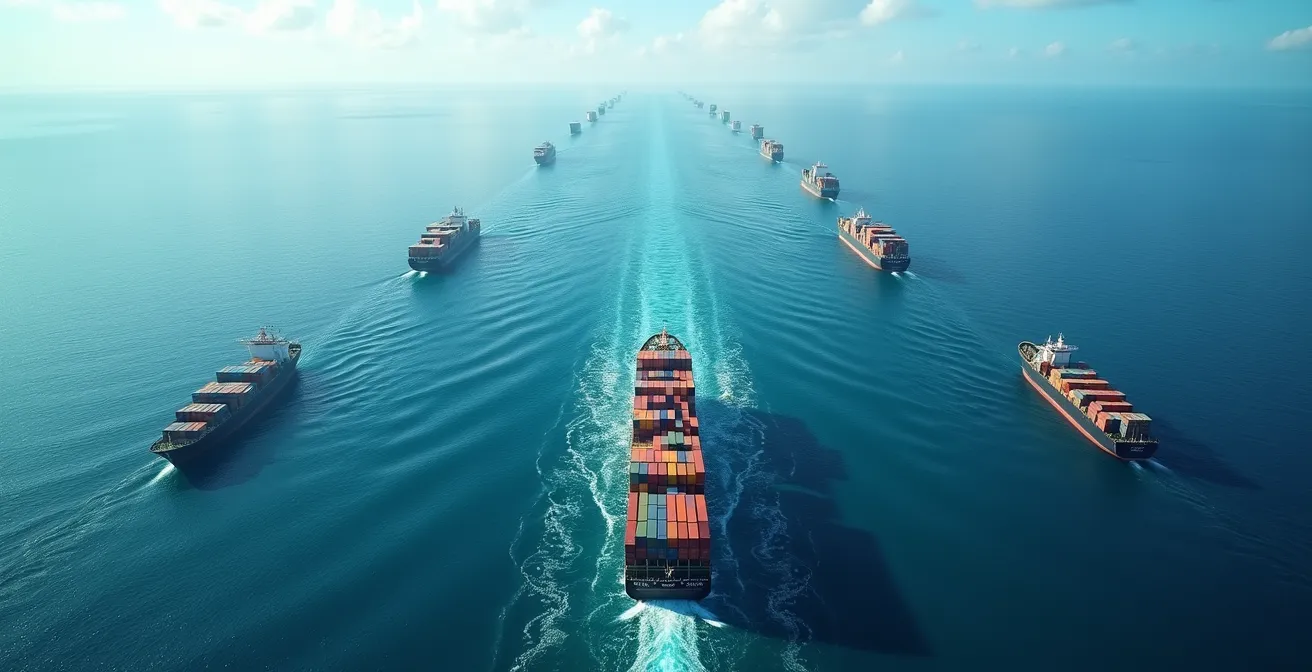
The greatest threat in a carrier collapse isn’t the loss of capacity; it’s the failure of a static contingency plan that was never truly tested.
- Resilience is not a backup list; it’s a dynamic capability built through regular, rigorous “fire drills” that test your entire response system.
- Shifting focus from pure cost metrics (cost-per-unit) to resilience KPIs (Time-to-Recover) is critical for strategic management.
Recommendation: Immediately shift from passive contingency planning to an active “war-gaming” posture, scheduling your first supply chain crisis simulation within the next quarter.
The notification arrives without warning: a strategic carrier, responsible for a significant portion of your global freight, has filed for bankruptcy. Vessels are arrested, cargo is frozen, and a critical artery of your supply chain has just been severed. For a Supply Chain Director, this is not a theoretical problem; it’s a catastrophic scenario that threatens production lines, customer commitments, and the company’s bottom line. The immediate scramble for alternative capacity is a reflex, but it often exposes a deeper, more dangerous vulnerability.
Conventional wisdom dictates diversifying partners and monitoring their financial health. While necessary, this advice is dangerously incomplete. It fosters a false sense of security, treating resilience as a static checklist. The reality is that true business continuity is not about having a Plan B on a server somewhere; it’s about possessing the organizational “contingency muscle” to execute that plan under extreme pressure. This involves understanding the hidden risks of single-sourcing, the strategic nuances of capacity agreements, and the cascading failures that can ripple from a single partner’s collapse.
This guide moves beyond the platitudes. We will not simply advise you to “have a backup plan.” Instead, we will adopt the mindset of a risk management consultant, focusing on the systemic frameworks and actionable processes required to build a supply chain that doesn’t just survive a carrier implosion, but adapts and maintains continuity. It’s time to shift the paradigm from passive risk mitigation to active, operational war-gaming.
This article provides a structured approach for Supply Chain Directors to fortify their networks against carrier failure. We will dissect the threats, explore advanced planning techniques, and outline a clear path toward embedding true resilience into your operational DNA. The following sections offer a comprehensive roadmap.
Summary: A Strategic Framework for Carrier Disruption Resilience
- Why Relying on a Single Strategic Partner Threatens Your Business Continuity?
- How to Map Backup Transport Corridors Before the Primary Route Fails?
- Fixed Allocation vs Block Space Agreements: Which Guarantees Uplift During Peak Season?
- The Mistake of Using Regional Carriers for Global Continuity Plans
- When to Run a “Fire Drill” for Your Logistics Supply Chain to Test Resilience?
- How to Adapt Your Supply Chain to Unexpected Market Shifts in Under 30 Days?
- How to Maintain Operational Continuity When a Major Hub Goes Offline?
- How to Realign Strategic Management of Global Supply Chains for Resilience Over Cost?
Why Relying on a Single Strategic Partner Threatens Your Business Continuity?
The most immediate danger of single-sourcing with a transport provider is obvious: if they fail, your cargo stops moving. However, the true threat to business continuity runs much deeper than a simple capacity loss. Over-reliance on one partner creates a form of strategic capture, where your own processes, data formats, and technology stack become intertwined with theirs. When they collapse, you are not just losing a carrier; you are losing a piece of your operational infrastructure, making a switch to an alternative exponentially more difficult and costly.
This dependency creates systemic fragility. The risk is often hidden layers deep within the supply chain. According to an analysis by Resilinc, over 85% of disruptions occur in the lower tiers of the supply chain, a blind spot for many organizations. A single carrier bankruptcy can trigger a cascade of failures among their subcontractors—drayage companies, warehouses, and customs brokers—that your organization may not even know it depends on. This network effect can paralyze your operations even if you secure alternative line-haul capacity.
Furthermore, a single-partner strategy erodes your market intelligence and negotiation leverage. Without comparative data from other carriers, you are blind to competitive pricing, service innovations, and emerging risks. You pay a hidden premium for this lack of visibility. To counter this, a robust business continuity plan must enforce a hard limit on dependency, ensuring no single carrier ever handles more than 50% of total volume on any critical trade lane. This isn’t just about risk diversification; it’s about maintaining strategic control over your own supply chain.
How to Map Backup Transport Corridors Before the Primary Route Fails?
Contingency planning is not a theoretical exercise; it is the rigorous, proactive mapping of viable alternatives. Simply having a list of backup carriers is insufficient. A resilient strategy requires pre-vetted, multi-modal transport corridors that can be activated at a moment’s notice. This means looking beyond like-for-like replacements (sea freight for sea freight) and building a network of dynamic redundancy that includes sea-air combinations, transcontinental rail, and long-haul trucking routes.
Case Study: The Hanjin Shipping Bankruptcy
The 2016 collapse of Hanjin, which instantly removed 3% of global shipping capacity, serves as a stark lesson. An estimated $14 billion in cargo was stranded, creating chaos for companies heading into the peak holiday season. Businesses with pre-mapped and pre-vetted backup corridors, including air freight and cross-country rail, were able to minimize disruption by rerouting cargo in a matter of days. In contrast, those without a detailed plan faced crippling port congestion, chassis shortages, and exorbitant spot market rates, with delays lasting for weeks.
Mapping these corridors involves more than just identifying routes on a map. It requires documenting the precise cost and lead time profiles for each alternative, pre-vetting critical service providers at diversion points (like customs brokers and 3PLs), and establishing the legal and commercial frameworks to engage them. Modern approaches even involve creating Digital Twin simulations to model the impact of a primary route failure and test the viability of backup options virtually before a crisis hits.

The goal is to move from a reactive scramble to a pre-planned, systematic activation. This framework transforms a potential disaster into a manageable logistical pivot.
Action Plan: Multi-Modal Redundancy Mapping
- Map primary sea freight lanes with specific, named alternatives (e.g., Shanghai-Rotterdam via the Eurasian rail bridge).
- Document the detailed cost and lead-time profiles for each backup mode, including sea-air and pure rail options.
- Pre-vet and establish initial agreements with critical service providers at key diversion points, such as customs brokers, drayage firms, and warehouse operators.
- Utilize Digital Twin simulations to model the financial and operational impact of a primary route failure and virtually test the effectiveness of backup corridors.
- Reserve token capacity or establish Memorandums of Understanding (MOUs) with backup carriers to guarantee space and priority access during a crisis.
Fixed Allocation vs Block Space Agreements: Which Guarantees Uplift During Peak Season?
When a primary carrier fails, especially during peak season, access to capacity on alternative carriers becomes the single most critical factor. Simply having a relationship with other carriers is not enough; you need a contractual mechanism that guarantees your cargo will be loaded. This is where the strategic choice between Fixed Allocation contracts and Block Space Agreements (BSAs) becomes paramount for business continuity.
A Fixed Allocation agreement is the most secure option. It is a take-or-pay contract where you commit to and pay for a set amount of space on specific sailings or flights, whether you use it or not. While this offers the highest level of space guarantee, it comes at a premium and carries significant financial risk if your volume forecasts are inaccurate. It’s the ultimate insurance policy, but an expensive one.
A Block Space Agreement (BSA) offers a more flexible compromise. In a BSA, a carrier reserves a certain amount of capacity for you, but the terms can vary. A “Hard BSA” functions much like a fixed allocation, with penalties for non-utilization, offering strong protection. A “Soft BSA” is more of a gentlemen’s agreement, providing priority access but without a firm guarantee if the carrier overbooks. The key is negotiating a Hard BSA with your designated backup carriers as part of your contingency plan.
The choice between these instruments depends on your risk tolerance and the criticality of the product. The table below outlines the primary trade-offs for your strategic consideration.
| Aspect | Fixed Allocation | Block Space Agreement (BSA) |
|---|---|---|
| Space Guarantee | Guaranteed space at higher fixed cost | Reserved capacity with flexibility options |
| Price Risk | Risk of overpaying in soft market | Exposure to spot rate volatility |
| Cancellation Terms | Strict penalties for non-utilization | Soft BSA: Cancel without penalty Hard BSA: Pay for unused space |
| Peak Season Performance | Maximum protection but highest cost | Good protection if hard BSA secured |
| Flexibility | Low – locked into fixed volumes | Medium – can adjust within terms |
| Best Use Case | Baseline volume commitments | Seasonal flexibility needs |
The Mistake of Using Regional Carriers for Global Continuity Plans
In the frantic search for capacity after a global carrier’s failure, many companies turn to a patchwork of smaller, regional carriers to piece together a solution. While seemingly resourceful, this approach often creates more problems than it solves and can be a critical mistake in a global continuity plan. The primary issue is the loss of end-to-end visibility and unified liability, a phenomenon known as the “Interlining Black Hole.”
When cargo is handed off between multiple non-integrated regional partners, tracking data becomes fragmented or lost. Each handover point introduces a new risk of delay, damage, or administrative error. More importantly, in the event of a problem, determining liability becomes a nightmare of finger-pointing between carriers, leaving your company to absorb the financial loss. A global carrier provides a single bill of lading and a unified chain of custody; a regional patchwork does not.
Case Study: The Carillion Liquidation Cascade
The 2018 liquidation of UK construction giant Carillion exposed the danger of relying on shared regional supply networks. Carillion owed over £1 billion to some 30,000 suppliers, many of which were small, regional businesses also used by Carillion’s competitors. Its collapse triggered a domino effect of bankruptcies throughout the UK construction supply chain. The “Interlining Black Hole” effect amplified the crisis, as the loss of a central coordinating entity meant data, liability, and operational control vanished overnight across the entire regional network.
This does not mean regional carriers have no role. Their strength lies in surgical application. They can be invaluable as a last-mile or first-mile backup, or to create a temporary “bypass” around a single congested port or failed inland hub. The mistake is attempting to replace a seamless global service with a disconnected assembly of regional parts. The correct strategy is to integrate select regional carriers into your plan under strict conditions: they must adhere to your visibility platform standards, and you must have pre-negotiated unified liability agreements to close the interlining black hole.
When to Run a “Fire Drill” for Your Logistics Supply Chain to Test Resilience?
A contingency plan that has never been tested is not a plan; it is a theory. The most critical component of building supply chain resilience is the regular execution of “fire drills”—live simulations that test your people, processes, and systems against a crisis scenario. The question is not *if* you should run them, but *when* and *how often*. The answer lies in a trigger-based schedule rather than a simple annual calendar event.
These operational war-gaming exercises should be triggered by specific events that alter your risk profile. For instance, a drill should be mandatory within 30 days of onboarding any new Tier-1 supplier or carrier. Another critical trigger is any significant geopolitical event affecting a key trade lane, requiring a rapid simulation to test alternative routes. Even a drop in a primary carrier’s credit rating below investment grade should automatically initiate a desktop walkthrough of the failure protocol. This transforms resilience from a passive document into an active, living process.

The frequency and intensity of these drills should vary. Quarterly desktop simulations allow the crisis team to talk through their roles and decision trees in a low-cost environment. Annually, a live test—routing a single, non-critical container through a designated backup corridor—provides invaluable, real-world feedback on the friction points in your plan. Given that a recent McKinsey survey found that nearly 90% of companies encountered supply chain challenges in 2024, treating these drills as an optional luxury is a grave strategic error. They are an essential investment in building the contingency muscle your organization needs to perform under pressure.
How to Adapt Your Supply Chain to Unexpected Market Shifts in Under 30 Days?
The failure of a major carrier is a seismic market shift that demands an immediate, decisive response. The ability to adapt your entire supply chain in under 30 days is the ultimate test of resilience. This speed is impossible with traditional, bureaucratic decision-making. It requires a pre-defined Rapid Response Framework that empowers the logistics team to act with speed and authority from the moment a crisis is declared.
The first 48 hours are critical. A core component of this framework is the ability to bypass standard multi-level approvals for logistics decisions during this initial period. The crisis response team must have pre-authorized spending limits and the authority to book premium freight or secure emergency warehousing without delay. This is enabled by activating a dedicated Contingency Fund, an operational budget set aside specifically for crisis recovery, preventing accounting hurdles from slowing down the physical response.
In the weeks that follow, the focus shifts to deploying pre-configured solutions. This is where the concept of modular supply chain design comes into play. Instead of rebuilding from scratch, you activate “plug-and-play” modules—pre-vetted carriers, 3PLs, and regional sourcing options that can be switched on quickly. This could involve activating a sea-air service to expedite critical components or shifting a portion of production to a pre-qualified secondary supplier in a different region. With a 38% year-over-year increase in supply chain disruptions recorded in 2024, having this agile response capability is no longer optional.
By the fourth week, the goal is to have established a new operational baseline. This rapid adaptation cycle—from crisis activation to a new steady state—is only possible through rigorous pre-planning. The 30-day framework is not about improvisation; it’s about the disciplined execution of a well-rehearsed playbook.
How to Maintain Operational Continuity When a Major Hub Goes Offline?
A carrier bankruptcy is just one type of failure point. Equally devastating is the sudden loss of a major logistics hub—a key port, a central distribution center, or even a unique manufacturing site—due to natural disaster, labor strikes, or infrastructure failure. When a critical node in your network goes offline, all routes leading to and from it become useless. Maintaining operational continuity in this scenario requires a “Shadow Hub” strategy.
A Shadow Hub is a secondary or tertiary location that can be activated to take over the functions of the primary hub. This is not just an empty warehouse. A true shadow hub strategy involves maintaining dormant, low-cost contracts with 3PLs in these alternate locations. It also involves the strategic pre-positioning of a small amount of critical inventory or components at these regional nodes, acting as a buffer to maintain production while larger volumes of cargo are rerouted.
Case Study: Hurricane Impact on High Purity Quartz Supply Chain
The impact of Hurricane Helene on Spruce Pine, North Carolina—the world’s primary source for High Purity Quartz (HPQ)—is a perfect example of the hub failure cascade effect. The temporary shutdown of this single location crippled the global supply of HPQ, affecting the production of semiconductors, solar panels, and electronics worldwide. Companies with effective Shadow Hub strategies and pre-signed MOUs with alternative 3PLs were able to activate secondary processing and distribution locations within 24-48 hours, while others faced extended, costly production halts.
The moment a primary hub goes offline, a Cargo Triage Protocol must be activated within hours. This protocol dictates the immediate diversion of all in-transit shipments to the designated shadow hub. It requires pre-defined diversion authority, clear communication trees, and pre-arranged cross-docking services to facilitate the rapid rerouting of stranded cargo. This proactive approach prevents a bottleneck from becoming a complete network shutdown, allowing operations to flow around the point of failure rather than grinding to a halt.
Key Takeaways
- Static contingency plans are insufficient; resilience requires dynamic, testable systems and a “war-gaming” mindset.
- True network redundancy is multi-modal, involving pre-vetted sea-air, rail, and trucking corridors, not just backup sea carriers.
- The strategic focus must shift from minimizing cost-per-unit to optimizing resilience KPIs like Time-to-Recover (TTR) and Value-at-Risk (VaR).
How to Realign Strategic Management of Global Supply Chains for Resilience Over Cost?
For decades, the primary directive of supply chain management was cost optimization, driven by lean manufacturing and just-in-time (JIT) principles. The recent era of unprecedented disruption has exposed the inherent fragility of this model. The new strategic imperative is a fundamental realignment toward resilience over pure cost efficiency. This is not about abandoning cost management, but about integrating risk into the equation to calculate a true, risk-adjusted total cost.
This realignment requires a new set of metrics. Traditional KPIs like cost-per-unit and inventory turns are dangerously incomplete because they do not account for the cost of disruption. Forward-thinking organizations are adopting a new balanced scorecard of Resilience KPIs. These include metrics like Time-to-Recover (TTR), which measures how quickly you can return to full capacity after a disruption, and Value-at-Risk (VaR), which quantifies the potential financial losses on any given trade lane. This shift in measurement is fundamental to changing behavior and investment decisions. The fact that a 2024 McKinsey survey indicates that 47% of companies plan to maintain or increase inventories rather than reduce them signals this broader strategic pivot is already underway.

Moving from a cost-centric to a resilience-focused strategy means making tangible investments in redundancy that may look “inefficient” on a traditional balance sheet. This includes paying for Hard BSAs that go unused, maintaining contracts with Shadow Hubs, and funding regular fire drills. The key is to frame these not as costs, but as insurance premiums that protect the entire enterprise’s ability to generate revenue. The board and C-suite must be educated to see resilience as a competitive advantage and a crucial enabler of long-term profitability.
This strategic pivot is best understood by comparing the old paradigm with the new. A recent analysis highlights the new KPIs that leading firms are adopting to measure and manage for resilience.
| Traditional Metric | Resilience-Focused KPI | Business Impact |
|---|---|---|
| Cost per unit | Risk-Adjusted Total Cost | Factors in probability of supplier failure |
| Delivery time | Time-to-Recover (TTR) | Measures speed of crisis response |
| Supplier price | Supplier Resilience Score | Evaluates financial stability and backup options |
| Inventory turns | Value-at-Risk (VaR) per trade lane | Quantifies potential disruption losses |
| Transport cost | Modal Flexibility Index | Assesses ability to switch between transport modes |
Begin the process of transforming your supply chain from a fragile cost center into a resilient strategic asset. The first step is to benchmark your current capabilities against these advanced frameworks and identify the most critical gaps in your continuity strategy.